
Kicking is the most argued-about part of rugby. Too much of it and you are accused of killing the game, too little and you are giving up the territory battle. We wanted the actual numbers, so we measured tens of thousands of kicks across thousands of matches in the Framesports data, at every level of the game.
The average kick is shorter than you think
The average kick travels 24.8 metres, and the median is 25. People picture the booming 50-metre clearance, but that is the exception. The bulk of kicking is the 15-to-35-metre territorial nudge: the contestable box kick, the kick to the corner, the exit that just clears the danger zone.
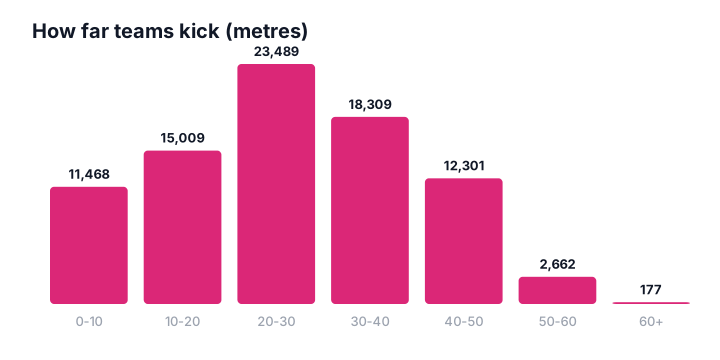
The distribution makes it obvious. The 20-to-30-metre band is the most common by some way, kicks over 50 metres are rare, and the very long kick is almost a novelty. Most kicking is about field position by increments, not spectacular distance.
Teams kick more than it feels like
Across our data, teams kick around 16 times a match. That is 16 moments where a side chooses to give the ball back in exchange for territory or a contest. Whether that is wise depends entirely on what you do with the territory, but it is worth sitting with the number: a meaningful share of every match is spent deliberately handing possession over.
The game is shifting to the contestable kick
Distance is the wrong thing to chase, and the modern game has worked that out. Coaches split the territorial kick, where you concede the ball for length, from the contestable kick, the box kick or high ball you are trying to win straight back, and the whole direction of travel is towards the second kind. Total kicking has actually been falling, teams kick less, and for fewer metres, than they used to, but the contestable share has climbed sharply. In the 2026 Six Nations around a fifth of all kicks were genuinely contested, more than double the season before, and the box kick has gone from a rarity to roughly a quarter of all kicking over the past two decades. The trend is to kick less, but kick smarter.
Our own data shows how much of kicking now lives in that short, contestable range. More than four in ten kicks travel 20 metres or less, the home of the box kick and the up-and-under, not the booming clearance.
Two law changes drove the shift. The 50:22, trialled in 2021 and made law in 2022, rewards the precise kick to touch and forces defences to drop a man or two into the backfield to cover it, thinning the front line whether or not you ever attempt one. Then in late 2024 World Rugby cracked down on the “escort runners” who shield the catcher of a high ball, restoring a genuine aerial contest, and contestable kicking jumped again. The logic of a good contestable is simple: win it back and you have effectively turned the ball over around 30 metres upfield, worth more than several phases of carrying. Its value rides on hang time and the chase, not on distance, which is the opposite of how kicking usually gets judged.
More kicking, fewer tries (for that team)
Across matches, the teams that kicked more tended to score fewer tries themselves, and the pattern sharpens when you look at kicking as a share of a team’s game: the more a side kicks rather than passes, the fewer tries it scores. Ball-in-hand teams outscore kicking teams in our data, plainly. That is not proof that kicking is bad, it is often the right call. But it is a useful counterweight to the instinct that kicking is a free option, and it lines up with a wider truth the data keeps showing: possession and territory are weak predictors of winning, and sides have beaten good opposition with well under half the ball. Every kick is possession you have chosen not to use, and that choice has a cost in your own attacking output.
Kicking is a trade, not a mistake
So why kick at all, if it costs you tries? Because the same data shows the other side of the deal. The more a team kicks, the fewer turnovers it concedes, and the relationship is strong. Kicking is risk management: you give up attacking upside in exchange for not coughing the ball up in your own half. That is exactly why territory-based gameplans exist, and why they suit some teams. The mistake is not kicking, it is kicking without knowing which side of that trade you need. A side with a dominant pack and a ferocious chase can kick and squeeze all day. A side with strike runners and quick ball is often handing over its best weapon every time it lets go.
What this means for your team
Two practical takeaways. First, drill the kick you actually use: if your average kick is a 25-metre contestable rather than a 50-metre rocket, that is what your kickers and chasers should rehearse. Second, treat kicking as a decision with a price, not a default. If you are kicking 16-plus times a match, it is worth asking how many of those genuinely won territory and how many simply gave the ball away. That is exactly the kind of question data-driven gameplans are built to answer.
How we worked this out
Based on tens of thousands of kicks with a recorded distance, drawn from the Framesports data: millions of events across thousands of matches at every level of rugby, on the most accurate data collection system in the game, so the numbers are reliable. Figures reflect the analysed team’s kicks; we do not infer opposition data. For the wider picture, see rugby by the numbers, and for why these metrics matter, the metrics that actually matter.