For most of this year, this page told you that teams complete four tackles in five. Coaches read it, and some of them will have set targets against it. It was wrong. We reran the numbers across every variety of rugby, men’s and women’s, from amateurs to professionals, and the honest tackle completion figure is about seven in ten, not four in five. Here is what went wrong, because the mistake is more instructive than the correction.
The number we published counted the wrong thing
A tackle in our records is one of three things: made, missed, or an assist. The assist is the second or third defender arriving to help finish a tackle somebody else started. It is a genuine contribution and it is worth recording, but it is not an attempted tackle that either succeeded or failed, so it has no business sitting in a completion rate.
The original figure counted assists as completions. That quietly stacks the numerator with events that can never appear in the denominator as failures, and the rate floats upwards. When we recount the current data that way deliberately, we reproduce a number very close to the one we published, which is how we know that was the error rather than a different one.
The honest figure is about seven in ten
Counting only tackles that were attempted and either made or missed, completion across the data sits at a little over seven in ten. A typical team attempts somewhere close to a hundred tackles in a match, and roughly three in ten of them do not stick.
That is a materially different picture for a coach. Four in five sounds like a solid defensive baseline that most sides clear. Seven in ten says the average team misses close to thirty tackles a match, which is a far better description of what community rugby looks like on a Saturday, and a far more useful thing to measure against. If you have been marking your side down against the old number, you have been marking them against a professional standard by accident.
The collision numbers were wrong in the same direction
The same post claimed that around one made tackle in seven is dominant, meaning the tackler clearly wins the contact rather than merely completing it. That was also too generous. On the current data, only about one made tackle in ten is dominant, and the picture from the other side of the collision agrees: the ball carrier wins getting on for nine contacts in ten.
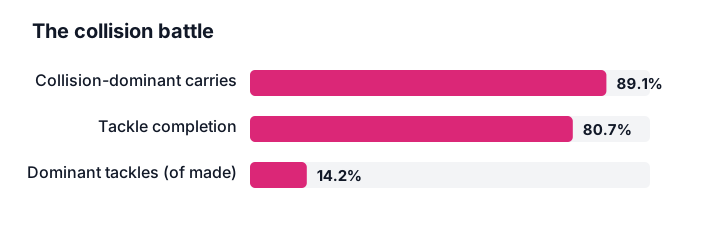
Those two figures come from separately recorded events, carries and tackles, and they describe the same moments from opposite ends. That they land within about a point of each other is the check that neither is a tagging artefact.
What to do with this
Stop using the old number, and be careful about where else it came from. If a completion rate anywhere looks close to a professional benchmark, the first thing to check is whether assists are in the numerator, because that single decision moves the figure by about ten points. For a realistic sense of what good looks like at amateur level, and how steeply completion tracks winning, we have a fuller breakdown of tackle completion and a post on who wins the collision that both use the corrected method.
How we worked this out
Based on the tackle and carry records across thousands of fully analysed matches spanning every variety of rugby, men’s and women’s, from amateurs to professionals, deduplicated so no fixture is counted twice. Completion is made tackles divided by made plus missed, with assists excluded from both sides of the division. We then recomputed the rate with assists deliberately included, and it landed close to the figure this page previously carried, which is the check that we have identified the actual error rather than a plausible-sounding one. Dominance is read from the contact verdict recorded on each event, and cross-checked against the carry stream, where the carrier-win rate and the tackler-loss rate describe the same collisions and agree within about a point. One honest caveat: a binary contact verdict has no neutral option, so “the tackler rarely dominates” is the defensible reading rather than “the carrier always breaks through”, and the two are not the same claim. Team figures reflect the analysed team’s events, the side of the game our data captures most completely.
Hero photo: existing image retained from the original version of this post.