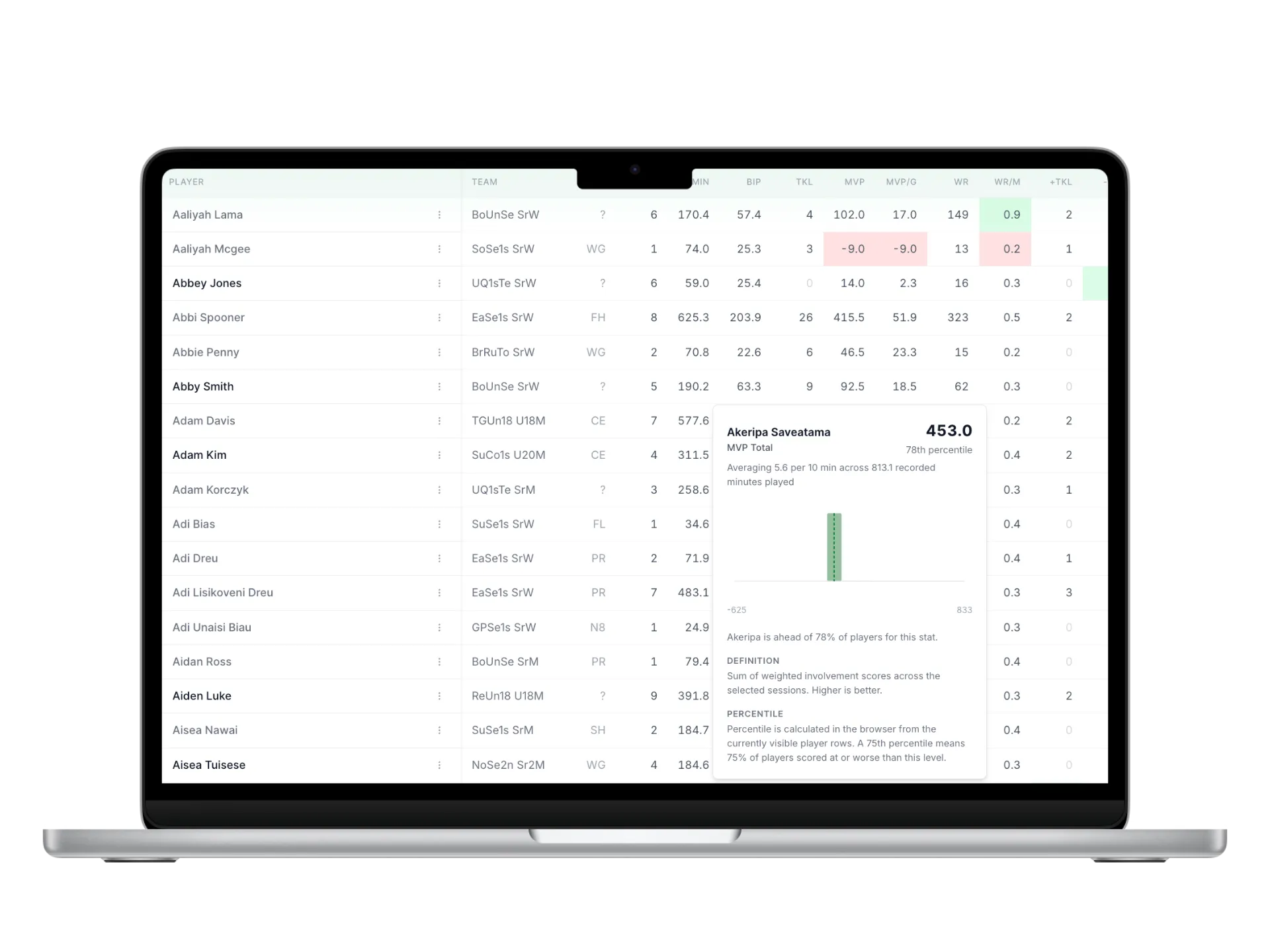
Run a competition or a region and the hardest thing to get is a clear view of the whole. Individual clubs see their own games, but nobody sees the system. The pathway, talent ID and competition intelligence suite gives governing bodies and regions exactly that: one view across every team, every grade and every competition they oversee.
It is the difference between managing a game club by club and understanding how the whole game is evolving, from grassroots to elite.
The whole system in one view
The suite lifts analysis from the single team to the entire system.
- A cross-team, cross-competition view. See performance and activity across every team in your structure, in one place, on consistent data.
- Talent identification across the system. Spot emerging players wherever they are, not just at the clubs that already shout loudest.
- Pathway development monitoring. Track how players and teams progress along the pathway, from the grassroots game up to the elite end.
- Complex queries, instant clips. The intelligence layer is built straight into the clips database, so you can run complex, system-wide queries and immediately get the exact video clips that answer them.
Talent, spotted objectively at scale
At system scale, talent identification stops being guesswork. Across thousands of players, the traditional answer is to send scouts out to watch as many as they can, which is slow, expensive, and unavoidably subjective. No group of scouts can see everyone, so genuine talent gets overlooked simply for playing at the wrong club on the wrong weekend.
A system-wide, data-driven view changes that. Every team is tagged to the same standard, so a standout performance at a small club counts for exactly as much as one at a flagship academy. A promising player is far less likely to be missed for playing in the wrong postcode, and a region can trust a talent signal because it sits on consistent data rather than on who happened to be watching. Age-grade and academy insights show how the pathway is actually producing players, and on-demand coding for non-first-grade sides means the talent below the top tier is finally visible too.
The result is a far more efficient pathway. Instead of chasing coverage with scouts and still missing people, a union identifies talent objectively across its whole system, and develops it as one rather than as a loose collection of clubs.
How it works
Competition intelligence is the system-wide view of the same data engine used everywhere else. Every match is captured to shared definitions, and AI aggregates that into a picture spanning a whole competition. It builds on data collection and is, in effect, multi-match trends at the scale of a union or region.
It is built to support the people running the game, not to take over their processes. Framesports surfaces the patterns and the talent, and selection, pathway and policy decisions stay exactly where they belong.
Who it’s for
Governing bodies are the primary audience, with large clubs and academy or pathway programmes close behind. A union gets a true picture of its game and the talent moving through it. A region gets to develop players with evidence rather than anecdote. A pathway lead gets to see every grade, not just the first team.
From grassroots to elite, this is how you understand the whole game at once. See what a system-wide view looks like with a demo, or explore who uses Framesports.