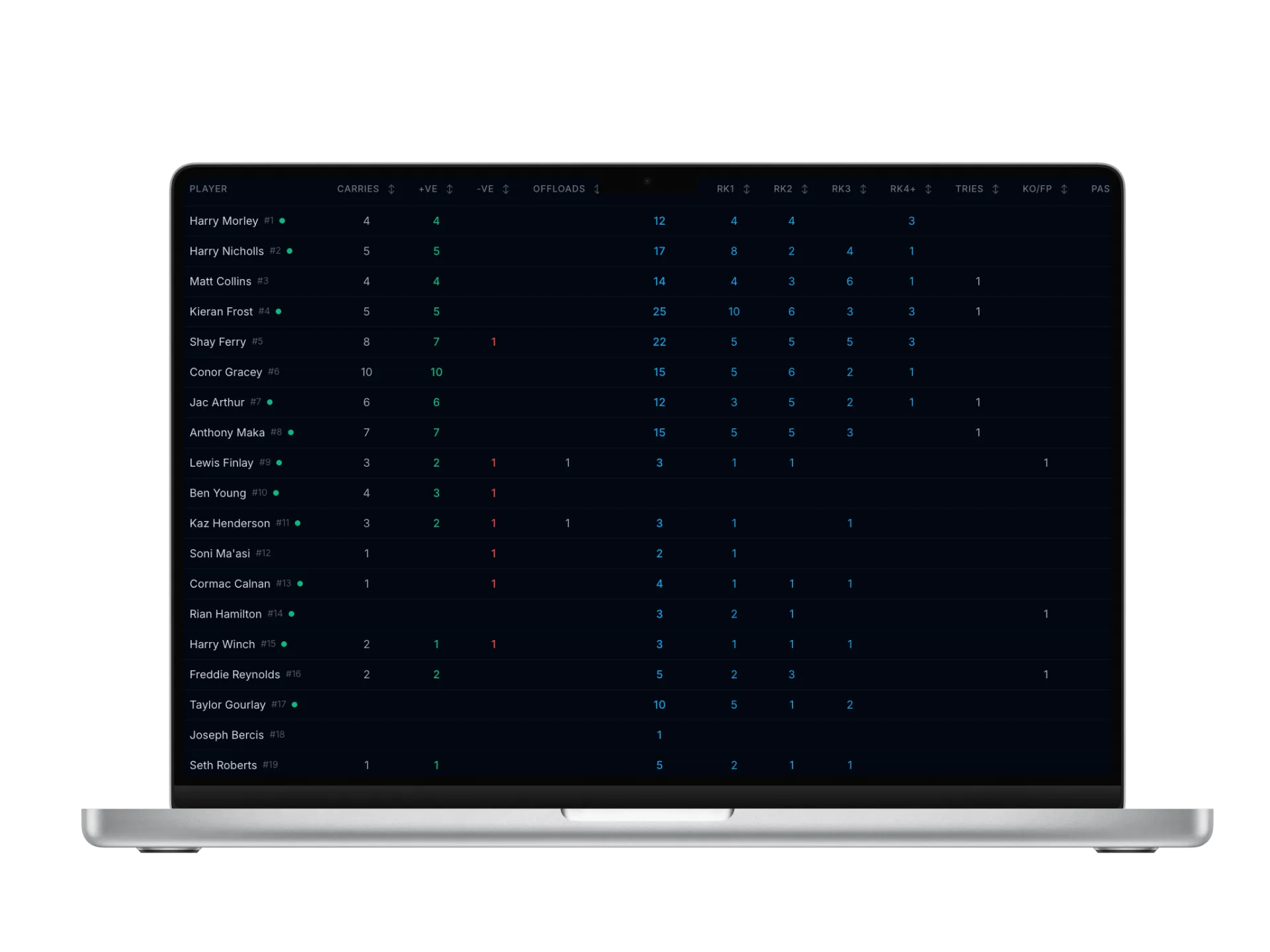
Every tool in Framesports starts with the same thing: clean, complete, hyper-granular data pulled from your match footage. We capture every individual player action and every team event in a game, then turn it into structured data you can actually work with.
It is the foundation the rest of the platform is built on, and it is the hard part most rugby analysis quietly skips. Get the data right, and everything downstream gets better. Get it wrong, and no dashboard can save it.
What we capture
Framesports records every event in a match, for every player, on both teams. Carries, tackles, rucks, passes, lineouts, scrums, kicks, turnovers and more are each tagged to the player who made them and the moment they happened. Alongside individual actions, we capture team-specific events, so you see structure as well as detail, from set-piece outcomes to phase counts to territory. Three things stand out from this process:
- Hyper-granular event tagging on every match. Nothing is rounded off or summarised away. Every action is recorded at the level a coach or analyst actually needs to answer a real question.
- A human-first approach. Every event in Framesports is tagged by a trained human, which powers our models and allows the data to be accurate and fast at the same time.
- Rapid turnaround. Your data comes back quickly after the final whistle, while it still matters for selection, review and the week ahead.
Per-player and team-specific data
Because every event is tied to both a player and a team, one dataset answers very different questions. You can follow a single player across a whole season, compare a unit like the front row, or study how an entire team performs in a given phase of play. The detail is there when you want to drill in, and the structure is there when you want to step back.
Every match in the system is held to the same standard. Consistent quality assurance means a grassroots fixture and an international Test are tagged to the same definitions, so your comparisons hold up and your trends are real rather than an artefact of who happened to tag the game. That consistency is what makes the data trustworthy enough to build selection, recruitment and development decisions on top of.
How it works
Rugby is messy. Scrums collapse, the weather turns, and a lot of what decides a match happens off the ball. Pure automation misses more of this than people expect, which is why our tagging process is built to capture what actually happened on the pitch, with AI taking over on the output side to manipulate it. Accuracy comes first, because everything downstream depends on it. You can read more about our process in how we work, human-first and AI-enhanced.
This foundation feeds everything else on the platform. The same events power the match analysis suite, surface season-long patterns in multi-match trends, drive individual player development, and supply the feeds behind broadcast graphics and social content. You build the data once, and every tool that touches it inherits the same depth and the same reliability.
Who it’s for
Data collection is the universal starting point, which is why it matters at every level of the game. A governing body standardising analysis across a competition, a professional team’s head of analysis, a referee society and an ambitious grassroots club all draw on the same engine and the same quality bar.
Footage and team sheets arrive automatically through our integrations, so the data captures cleanly with no manual entry and no mismatched names. From there it flows out to the rest of Framesports. From grassroots to elite, every level of rugby benefits from better data, and this is where that data begins. Take a closer look at how Framesports works, or upload a demo and see your own footage turned into a complete dataset.