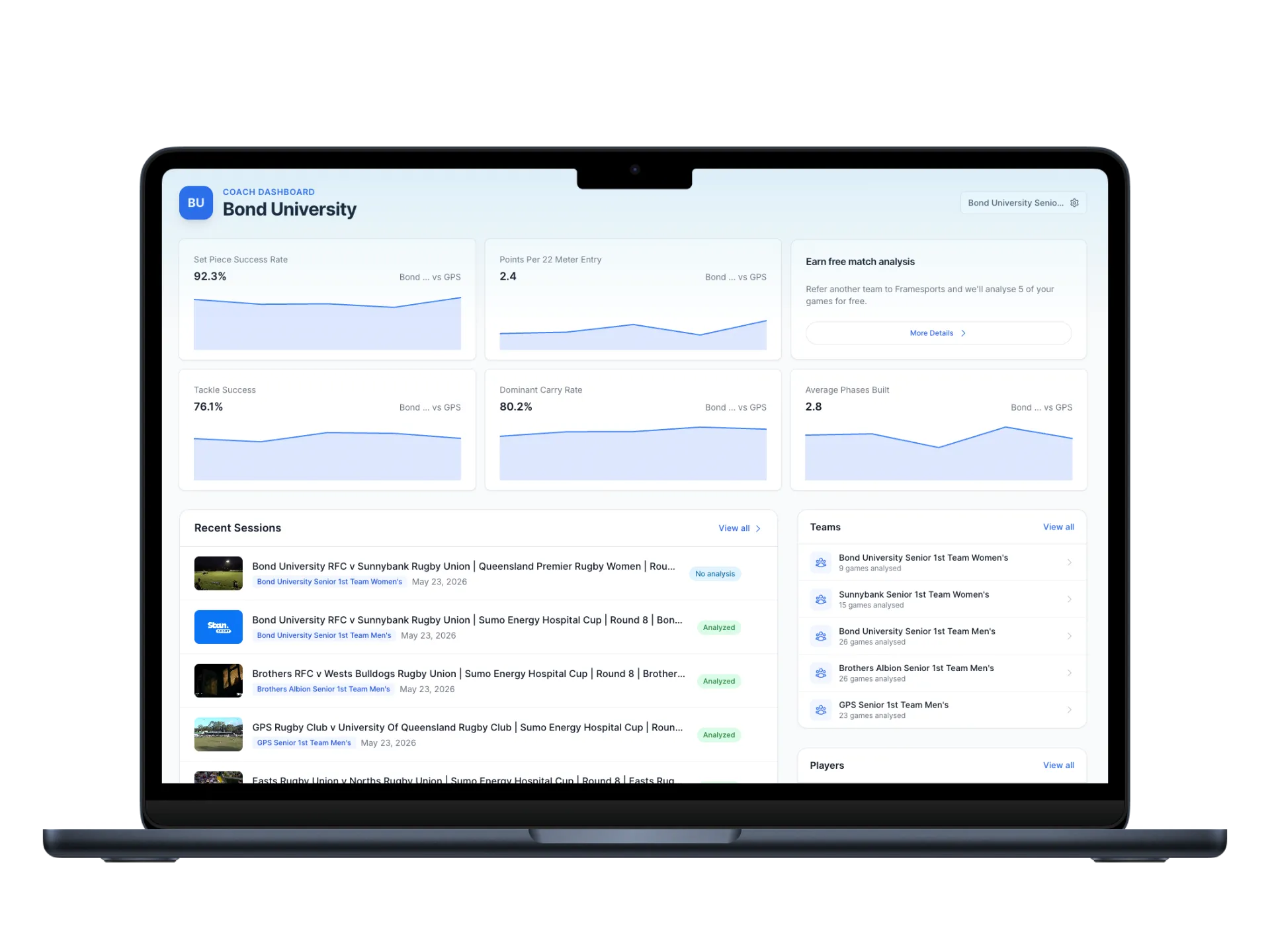
One match tells you what happened. A season tells you who you are. The multi-match trends and analysis suite looks across every game you have played and surfaces the patterns no single match could ever reveal.
It takes the same hyper-granular data behind every fixture and turns it into a long view: how a team is genuinely trending, how a player is developing, and where the season is heading.
Patterns across the season
The suite is built to find signal across games, not just within them.
- AI-driven trend analytics. Powerful analytics run across full seasons, tracking how teams and players move over time rather than in a single snapshot.
- Opposition tendency analysis. Study how an opponent plays across several matches, not one, so you prepare for their patterns rather than their last result.
- Player selection and scouting. See how players stack up against each other across the season, so selection meetings and recruitment calls are made on evidence rather than gut feel.
Opposition, player selection and welfare
Because the data spans every dimension, the suite answers questions that live above any one match. Trends run across teams, players, clubs, referees and entire competitions, and you can filter them on whatever matters to you. Compare performance over time, track a unit across a block of fixtures, or follow a single metric from the first round to the final.
Selection is where this matters most. Picking between two players who both had a good Saturday is a guess; picking between them on ten games of like-for-like data is a decision. The suite lines players up side by side across a season, by position, by minutes, by the specific things you actually weight, so the tough calls get made on evidence rather than on the last match anyone happened to watch.
Opposition work gets stronger the same way. A team that looked one-dimensional in a single game often shows a clear hand across ten of them: the side that kicks for territory the moment it falls behind, or the pack that fades in the final twenty minutes. Those are the tendencies that genuinely shape a game plan, and they only surface when you line up match after match against the same definitions. Read across a full season and the signal sharpens again, separating a real pattern from a single good or bad afternoon. For anyone planning a campaign rather than a week, that long view turns analysis from a record of what already happened into a guide for what to do next, and it applies as much to your own team’s habits as to an opponent’s.
How it works
Multi-match analysis is only as good as the data underneath it, which is why every event in every match is captured to the same definitions, and AI aggregates that consistent record into trends you can rely on. Without that consistency, season-long numbers are just noise. With it, they become evidence.
This suite is the natural step up from the match analysis suite, and it shares its foundation with data collection. Zoom out far enough across teams and competitions and it becomes competition intelligence for governing bodies and regions.
Who it’s for
Anyone thinking beyond the next match benefits here. Professional teams plan blocks of a season and scout opponents in depth. Large clubs track squads across grades. Governing bodies watch trends ripple across a whole competition. The depth scales to the question, and the welfare and opposition tools matter just as much to an ambitious amateur side as to a Test team.
From grassroots to elite, the season is where the real story lives. See it on your own data with a demo, or read more on the rugby metrics that matter.