University rugby looks like club rugby from the outside and behaves nothing like it. The competitive structure is similar, the standard often higher, and the resources usually thinner. But the thing that actually makes it different is turnover: a third of your squad leaves every summer, and the intake arriving to replace them comes from thirty different schools with thirty different vocabularies.
That reshapes what analysis is for. In a club, video is mostly about improving a settled group. In a university programme, it is mostly about getting a new group to a common standard fast, then proving what happened when nobody was keeping records.
The four jobs it actually does
Compressing the September learning curve. You have a handful of sessions before the first competitive fixture to get a squad that has never played together onto the same page. Showing people what you mean is faster than telling them, and it removes the ambiguity that costs you the opening block.
Selection you can defend. University selection is contested in a way club selection often is not, because players are ambitious, transient, and frequently convinced they are being overlooked. Clips and numbers turn a subjective conversation into a specific one. It does not make the conversation pleasant, but it makes it survivable.
Player pathways. A meaningful share of university players are trying to get somewhere, whether that is a senior club, an academy or a professional contract. A programme that can produce a credible highlight reel and a stats-backed record is a programme that recruits better, because that capability is visible to incoming students.
Institutional memory. Coaching staff in university rugby turn over almost as fast as players. A tagged, searchable archive is the only thing that survives a change of coach, and it is worth more here than anywhere else in the amateur game.
Where university programmes differ from clubs
The season is short and dense. BUCS and equivalent competitions pack a lot of rugby into two terms with exam-shaped holes in the middle. There is very little slack, which means a review process that takes three days is a review process that arrives after the next fixture.
There are multiple teams and one coaching group. Firsts, seconds, sometimes a thirds and a women’s programme, frequently sharing staff. Anything that only works for one team is not much use.
The budget lives somewhere unusual. It is rarely a rugby budget. Depending on the institution it sits with the students’ union, the sport department, a performance programme or an alumni fund, and each of those wants a different justification. Sport departments tend to respond to participation and retention. Performance programmes respond to results and pathways. Unions respond to student experience.
Nobody has a spare Saturday. The volunteer model that props up club analysis does not exist here. Students are the workforce and the students are playing.
The student analyst question
Most university programmes reach for the same answer: recruit a sport science student to run analysis for course credit or experience.
It is a good idea and it works, up to a point. What it does not survive is the point where it becomes tedious, which is tagging. A student analyst who spends their week marking up rucks learns very little and leaves. A student analyst who gets the tagged data and spends their week interpreting it, building session content and working with coaches learns a great deal and stays.
If you want the student-analyst model to work, the practical answer is to take the repetitive part away from them and give them the interesting part. That is also the honest argument for a done-for-you service in this setting: not that students cannot do it, but that the part they can do is the part worth their time.
Getting the pitch funded
Three things tend to unlock a university budget where a straight performance argument does not.
Retention and participation. Students who feel developed stay in the programme. If your funder measures participation, frame it there.
Recruitment. Prospective students choose programmes partly on what they will get out of them. A visible development and highlights capability is a recruiting asset, and it is one of the few that costs the same whether you have forty players or two hundred.
Reach across teams. Because the cost does not scale per team, this is unusually easy to justify as a departmental line rather than a first team one. Make sure the proposal covers every side that will use it, because a first-team-only ask is both harder to fund and less true to how it gets used.
What to have ready before round one
Squads entered and jersey numbers assigned for every team you intend to record, before the first fixture rather than after it. A named person responsible for filming each week, including who covers when they cannot. And a decision about which one or two things you will actually track across the season, made now, because nobody makes that decision sensibly in October.
If you are working out the sequencing, what your first three games will tell you is worth reading before you draw conclusions from the opening block, and the preseason analysis playbook covers the setup itself.
Our pricing is built for schools, universities and clubs rather than professional programmes, and it pauses out of season, which matters more in a university calendar than almost anywhere else.
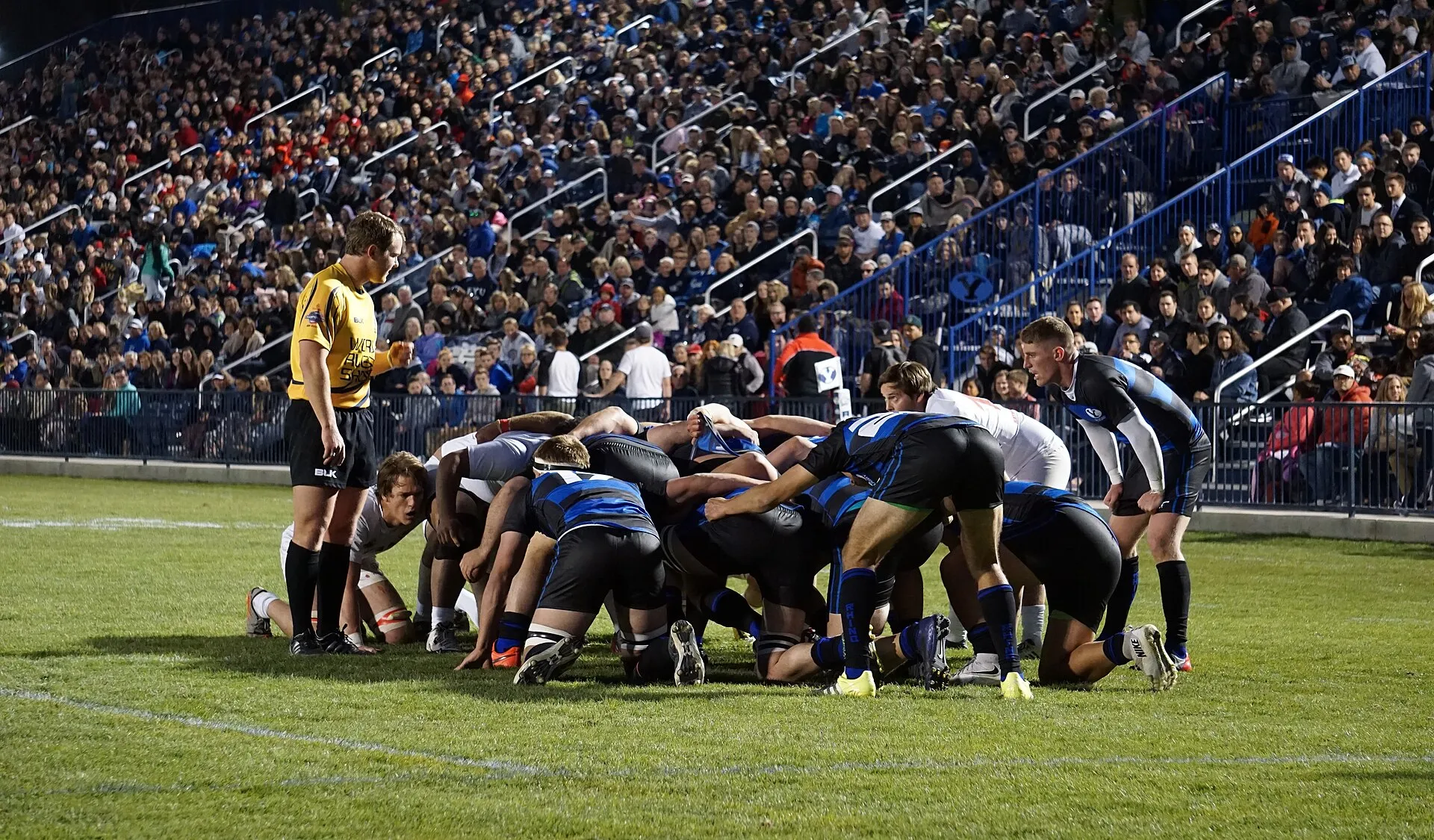
Hero photo: Bdhanson, CC BY-SA 4.0, via Wikimedia Commons.