Nearly every team that films at all films the first XV. The seconds play on the next pitch at the same time, in front of the same volunteers, and nobody points a camera at them. It is an odd allocation once you look at it, because the second team is where next year’s first team is, where the players who leave quietly are, and, in our match data, where the most fixable gap is. This is the case for filming the other pitch.
The seconds are the first team’s pipeline
Every first XV is built from the seconds. The nineteen-year-old who will start at ten in two seasons is playing second-team rugby now. So is the prop coming back from a knee, and the centre who was dropped in October and is either going to win the shirt back or drift off to a job in another town. The decisions that shape the first team in eighteen months’ time are being made on the second-team pitch this Saturday, and they are being made from memory, because there is no footage of it.
Nobody watches the seconds
Even where the seconds are filmed, the footage goes the way of most match footage: uploaded, never opened. The head coach was at the first-team game. The seconds’ coach has a job. Two hours of video with no signposts is a second matchday nobody volunteered for. So the players who most need somebody to have watched them play are the ones nobody watched, and they know it.
Same game, one big difference
We compared the senior men’s second and third teams in our data with the first XVs, across thousands of fully analysed matches with more than a hundred lower-team matches among them. The surprise is how alike the two games are. The seconds throw about the same number of passes, carry nearly as often, give away the same number of penalties, keep their lineouts at nearly the same rate and win the collision just as often. On most of what we measure, a second-team match is a first-team match.
The exception is tackling. The first XVs complete about three tackles in four. The seconds complete about seven in ten, a gap of roughly five points that runs all the way down the range: the weakest second-team performances land below the weakest first-team ones, and the best fall short of the best. The seconds also knock the ball on a little more often. Everything else is level.
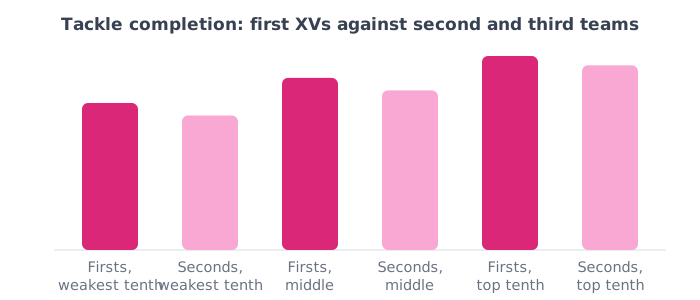
That matters because tackle completion is the number that travels with results: across a season, where a team’s completion rose by two points or more, its average margin rose by about eight. Nothing here shows that filming the seconds closes their gap; we have not measured that. What it shows is where the room is. A first XV sitting at three in four is chasing a number that barely moves. The seconds have five points of it, on the one measure that goes with the scoreboard when it does move.
Selection runs on the seconds’ footage, which does not exist
The hardest conversation at any rugby team is selection, and the contested shirt is nearly always contested between a first-team player and a second-team one. The first-team player has a season of footage. The second-team player has a coach’s memory of a game the coach did not see. Three clips per candidate settles most selection arguments in minutes, and you cannot cut three clips of a player nobody filmed. Every selection decision made without second-team footage leans, without anyone meaning it to, towards the player who happened to be on the filmed pitch.
The players who leave are on the seconds
Amateur teams lose players to jobs, injuries and drift, and the drift starts with feeling unnoticed. A named clip with a question attached is proof that somebody watched you play, and it is the cheapest retention tool a team has. The first team already gets that. The seconds, the squad where a player is always one bad month from packing it in, get a score in a group chat. Filming them and sending each player their carries on Sunday night costs almost nothing, and for some of them it is the difference between staying and leaving.
It does not take a second coach
The objection is time. The seconds’ coach cannot watch two hours of footage a week either, and the first-team coach cannot watch four. That is what buying the analysis rather than the footage is for: the match comes back tagged, the clips are already cut, and the seconds’ coach gets the same twenty minutes of prepared material on a Tuesday that the firsts get. Analysis is meant to give coaches time back, so the hours go into the players rather than the scrubbing, and there is no squad where that trade is better than the one nobody was watching.
How to start
Film the seconds’ next home game with whatever you filmed the firsts with, from the same spot; the filming rules are the same. Send the footage in the same way. Give the seconds’ coach one thing to look at in the first week, tackle completion, and send five players their own clips. That is the whole plan. A month into the season it is not too late to start, and a second team costs a fraction of what people assume.
The figures here come from senior men’s teams in thousands of fully analysed full-length matches, with each team’s level taken from how it is set up on our platform: first team, or second and third team. Tackle completion is tackles made as a share of tackles attempted, assists excluded, for matches with enough attempts to count. The lower-team sample is over ten thousand tackle attempts across more than a hundred matches from thirty teams, smaller than the first-team one, and analysed second teams are often the stronger side in their fixtures, which if anything narrows the gap.
Hero photo: Got Rugby, CC BY-SA 2.0, via Wikimedia Commons.