Most filming advice assumes a dry Saturday in September. Then it is November, the rain is coming sideways and the light goes by the final quarter. Bad weather rarely ruins footage by itself. What ruins it is a wet lens nobody noticed, a tripod that went over at half time, or a phone that died in the cold with twenty minutes left.
This assumes you already know where to stand and how high to get. The same goal runs through everything below: keep the shirt numbers readable. A grey, grainy picture with readable numbers is a usable match. A smeared lens can lose the numbers altogether.
Rain: keep the lens dry
One drop on the lens can blur part of the picture for the rest of the half, and on a small screen in the rain the person filming will not see it. So shelter comes first. If a stand or a gazebo gives you cover at the halfway line, use it, as long as you keep your height.
If there is no shelter, give the camera its own. A lens hood or a proper rain cover is cheap for a camcorder. For a phone, a clear plastic bag with a hole cut for the lens and an elastic band around it will do the job. A wet touchscreen can register phantom taps that stop the recording, so keeping the glass dry matters more than the phone’s water rating.
Keep two or three microfibre cloths in a sealed bag, and look at the lens at every stoppage. Wipe it with a dry cloth, never with a wet shirt sleeve, which only spreads the water around.
Auto-tracking cameras are built to live outdoors, but a drop on the lens blurs their picture too. Check the lens before kick-off and again at half time.
Cold: look after the battery
Batteries drain faster in the cold, and a phone that was at half charge at kick-off may not see out the match. Start at full charge, keep a spare battery in an inside pocket, and run a power bank to a phone from a dry bag.
Do not take the camera into the warm clubhouse at half time. A cold lens fogs as soon as it meets warm, damp air, and it can take longer to clear than half time lasts.
Wind: go lower and add weight
Wind is what puts tripods on the floor. Keep the legs wide, drop the tripod a section if it is gusting, and hang your kit bag from the centre hook so it holds the whole thing down. Stand on the side of the camera the wind is coming from, so that you take some of it.
A camera shakes more at full zoom, so come out a little on a windy day. You lose some detail on the far side, and you gain a picture that can be watched.
If you use a tall pole or a mast, read the maker’s wind limit before the weekend and follow it. Take a section out, tie it off, or both. A falling mast can hurt someone, so nobody should stand under one in a gale to save a recording.
Low sun: keep it behind you and the sky out of shot
Autumn sun sits low all afternoon. If you can choose your side of the pitch, film with the sun behind you. Looking into it turns players into silhouettes, and nobody can read a number on a silhouette.
Tilt the camera down so that there is as little sky in the frame as you can manage. A bright sky pulls the exposure down and leaves the players dark. Lock the exposure if your camera or phone allows it, so that the picture does not pump every time the sun comes out or a stand’s shadow crosses the pitch. Set it again at half time, because the light will have changed.
Failing light and floodlights
By late November the sun sets around four across much of the UK, so a half-past-two kick-off ends in fading light. As it gets darker, a camera raises its sensitivity, which adds grain, or slows its shutter, which adds blur. You cannot stop that, but you can avoid making it worse:
- Stay at 25 frames a second, or 30 in North America. Higher frame rates need more light.
- Avoid digital zoom, which enlarges the grain as well as the picture.
- Clean the lens again at half time, because floodlights turn smears into glare.
Floodlights can also flicker on camera, because they pulse with the mains power. In the UK, Ireland, most of Europe, Australia, New Zealand and South Africa, film at 25 frames a second, and if your camera lets you set the shutter speed, use 1/50 or 1/100 of a second. In North America, film at 30 frames a second with a shutter speed of 1/60 or 1/120. Set this up before the first floodlit match, and film a short test under the lights so that you know what you will get.
If it goes wrong, keep going
A second phone on a small tripod, filming wide for the whole match, is the cheapest insurance there is. If the main camera stops, restart it and carry on. Two files are fine, and when you upload to Framesports you can add them as one camera filmed in parts and they are joined into one match. A short gap costs you a few minutes of play, and the rest of the match is still worth having.
What to put in the bag
- Two or three microfibre cloths in a sealed bag
- A rain cover, or a clear bag and elastic bands
- A spare battery, or a power bank and cable in a dry bag
- Something heavy for the tripod hook
- A second phone and a small tripod
What to do with the footage
Rough footage is still worth using, as long as the numbers are readable. Players are matched to their stats by the number on the shirt, so that is what to protect. Framesports takes the footage from any camera or phone, or a link to where it already sits, and returns the match tagged, with clips and player stats. If you are still choosing a camera for the rest of the winter, the camera guide compares the options and the budget guide covers the cheaper ones.
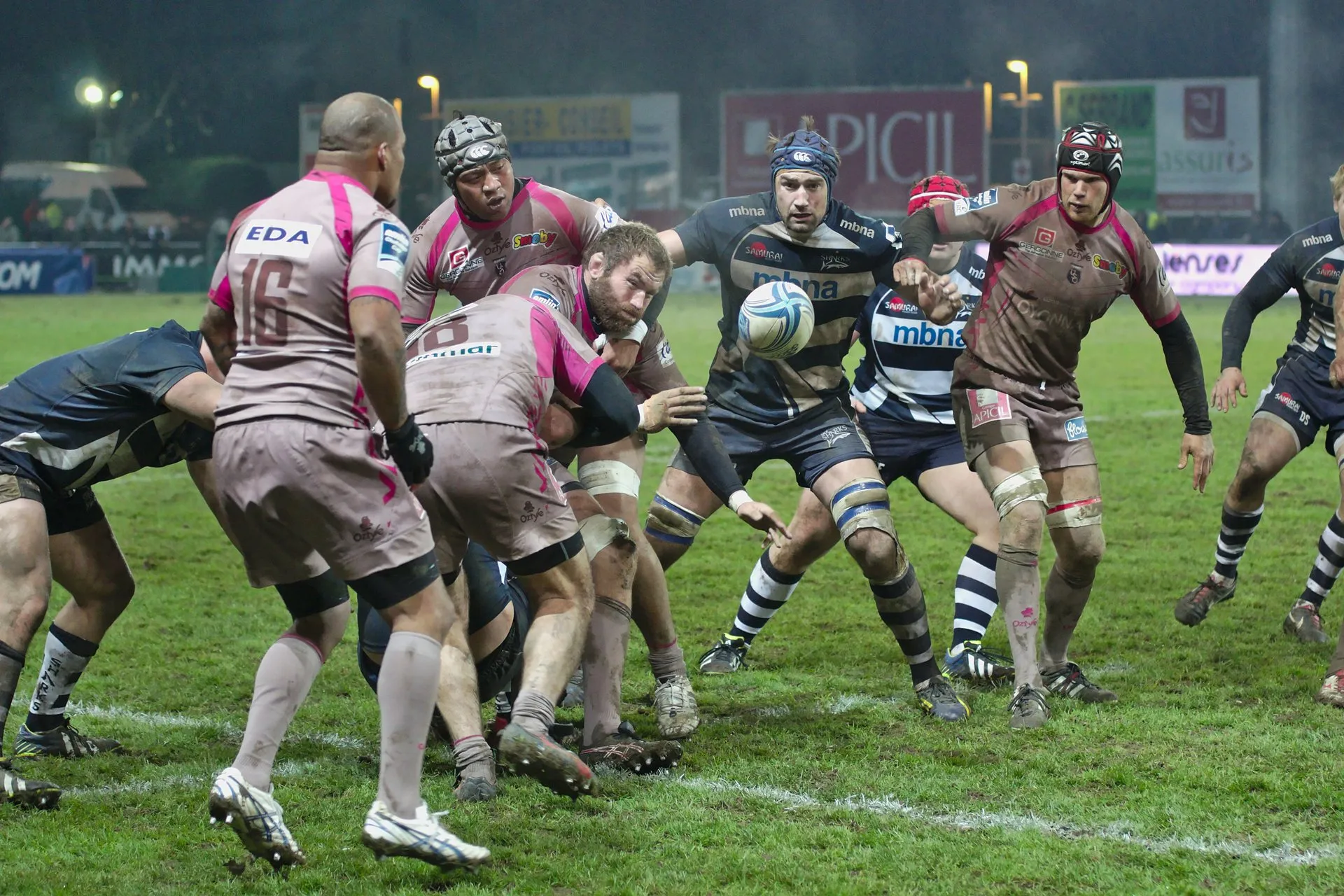
Hero photo: Clément Bucco-Lechat, CC BY-SA 3.0, via Wikimedia Commons.