“Start fast” is the most repeated instruction in rugby, and this page used to put a number on it that was far too flattering. We reran it properly across every variety of rugby, men’s and women’s, from amateurs to professionals. The team leading at twenty minutes goes on to win about three times in four - a real edge, and a long way short of the near-certainty we previously published.
A one-score lead at twenty minutes is worth less than it feels
Split early leads by size and the picture is much more interesting than a single headline rate. Where the lead at twenty minutes is inside a converted try, the team in front wins about two matches in three. That is better than a coin toss and it is nothing like decisive. A seven-point cushion twenty minutes into a game of rugby is worth roughly what your instinct says it is worth, which is to say: something, but not the match.
The corollary matters more for the side behind. Trailing by a score at twenty minutes, you win about one match in three. That is a perfectly live game, and it is worth saying so on the touchline rather than letting heads drop.
Two scores is where the game starts to close
Push the lead past two converted scores and it changes character. Teams leading by eight to fourteen points at the twenty-minute mark win around six matches in seven, and beyond fifteen points the game is close to decided, with the leader winning better than nine times in ten.
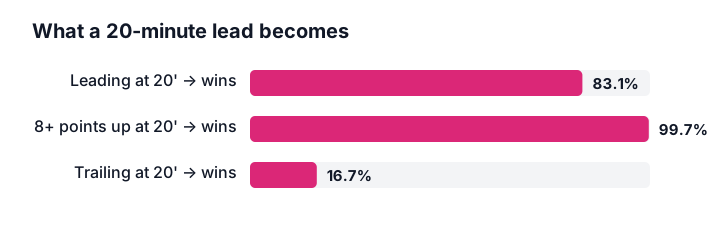
The shape of that climb is the useful part. The gap between a one-score and a two-score lead is much larger than the gap between two scores and three. Twenty minutes in, the difference between seven points and nine points is worth far more than the two points suggest.
We previously published a number that was far too confident
The version of this post that stood until today said an eight-point lead at twenty minutes was converted into a win better than ninety-nine times in a hundred. On the current data the true figure is closer to nine in ten. That is still a strong position and it is not the same claim at all, and the difference between them is exactly the sort of thing a coach might plan around.
The old figure came from an early, skewed snapshot of the data taken before we deduplicated fixtures and excluded practice records. It also described the opening as almost never scoreless, where in truth around one match in fifteen has no points at all after twenty minutes. We have replaced both.
What to do with this
Treat twenty minutes as information, not a verdict. If you are a score up, the honest reading is that you have earned an edge you can still lose, which argues for taking the points on offer rather than chasing the game-killing try. If you are a score down, the data says you are in roughly a one-in-three position, which is worth more to a struggling side than a rousing speech. And if you are two scores down, the useful question is not whether you can win but what you want to have fixed by the time you play this opponent again - which is where going back through the footage earns its keep.
How we worked this out
Based on the scoring events across thousands of fully analysed matches spanning every variety of rugby, men’s and women’s, from amateurs to professionals, deduplicated so no fixture is counted twice. We reconstructed each scoreline from tries, conversions, penalties and drop kicks, took the state of that scoreline twenty minutes into the recorded play span, and compared it with the final result, excluding matches that finished level because a derived scoreline is not precise enough to call a dead heat. The reconstruction has been validated against independently recorded final scores and is reliable in aggregate rather than for any single match, which is why every figure here is a rate across many games. One honest caveat: our clock is the match as recorded, including stoppages, so the twenty-minute mark is twenty minutes of footage rather than twenty minutes of the referee’s watch, and it will run slightly ahead of the official clock. Team figures reflect the analysed team’s events, the side of the game our data captures most completely, and analysed teams are often the stronger side.
Hero photo: existing image retained from the original version of this post.