Every half-time team talk in a losing dressing room makes the same promise: this is not over. We wanted to know how often that is actually true. So we rebuilt the half-time score in about three thousand fully analysed matches, from every variety of rugby, men’s and women’s, from amateurs to professionals, and followed each one to the final whistle.
About one trailing team in six turns it around
Across every match with a half-time leader, the trailing side came back to win about one time in six, with a small extra handful salvaging a draw. Put the other way, just over four half-time leads in five survive. That is the honest baseline for the speech: not over, but the hill is real. What the average hides is that the size of the deficit changes everything.
Within one score, it is barely a deficit at all
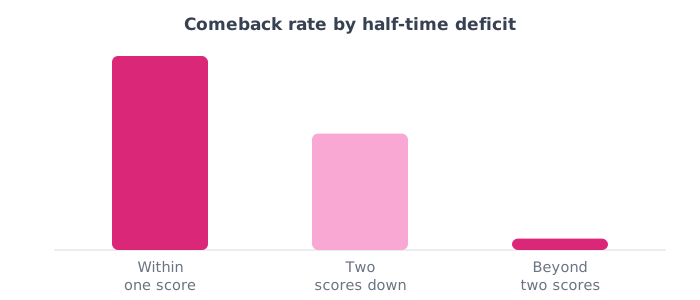
Teams that reached the sheds within seven points completed the comeback nearly one time in three. Add the draws and the picture gets friendlier still. A one-score game at the break is simply a live game: the restart, the first penalty, one defensive lapse, and the whole thing flips. If that is your dressing room, the data says the talk should sound like a plan, not a rescue.
Two scores is the cliff edge
Go in eight to fourteen points behind and the comeback rate drops to just under one in five. Beyond fifteen points it collapses to about one in fifty. That middle band is the game’s real cliff edge: the difference between seven down and ten down at the break is worth far more than three points of scoreboard. Which reframes the end of the first half. Conceding just before the interval is not just momentum lost, it can be the score that moves you from one side of the cliff to the other.
What to do with this
For the trailing coach: diagnose which comeback you are attempting. One score down, stay calm and change little, because a third of teams in your seat finish the job. Two scores down, something specific has to change, a matchup, the kicking plan, the bench arriving early, since carrying on as you are has a poor record. For the leading coach: the lead most often lost is the small one, so the last five minutes of the first half and the first five of the second, the windows where scoring naturally spikes, are exactly where holding your shape earns the points that put the game past the cliff edge.
How we worked this out
Based on about three thousand fully analysed matches spanning every variety of rugby, men’s and women’s, from amateurs to professionals, deduplicated so no fixture is counted twice. We located each match’s half-time interval from the natural gap in the tagged events, keeping only matches where the break is unambiguous, then rebuilt the score at the break and at full time from tries, conversions and goal kicks, a method we have checked against externally recorded results. Matches level at the break, about one in twenty, are excluded from the comeback figures. Analysed teams are often the stronger side, but each comparison here is within a single match, leader against chaser, so that skew does not drive the pattern.
Hero photo: ペン太, CC BY 2.5, via Wikimedia Commons.