“Tries come in the last twenty minutes.” Every clubhouse says it, usually while explaining a defeat. We decided to check. We collected tens of thousands of tries, from every variety of rugby, men’s and women’s, from amateurs to professionals, and placed each one on the match clock. The cliche survives, but only just.
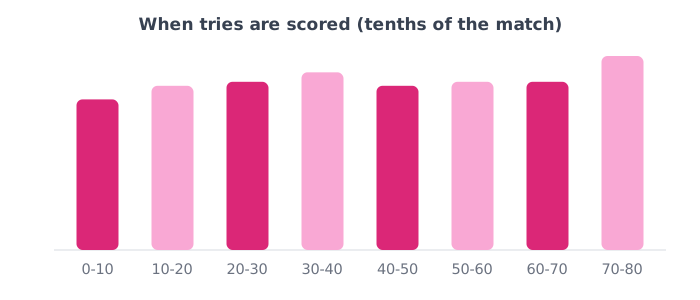
The opening ten minutes are the quietest of the match
The first finding is about the start, not the end. The opening ten minutes produce about one try in nine, the lowest of any stretch of the game. Fresh legs, set defences, kick tennis and nerves: whatever the mix, matches begin cagey. If your team has a habit of conceding early, that is not the game being cruel. It is unusual, and worth treating as a specific problem to fix.
Scoring builds towards the end of each half, not just the match
The pattern inside the halves is the interesting bit. Try-scoring climbs steadily through the first half and peaks just before the break, dips a little as the second half restarts, then climbs again all the way to the final whistle. Both halves have the same shape: quiet start, busy finish. Defences are freshest straight after a team talk and most ragged just before one, which is precisely when the scoreboard moves.
The final ten minutes is the busiest window, by about a third
The last ten minutes of the match produces about one try in seven, roughly a third more than the opening ten. So yes, the late surge is real: fatigue opens gaps, benches change the maths, and losing teams start chasing. But the gap between the busiest and quietest stretches is a lean, not an avalanche. Tries are spread across the whole match far more evenly than the folklore suggests, and the two halves end up sharing the total almost equally.
What to do with this
First, plan your bench around the data: the busiest scoring window arrives when your starters are at their most tired, so impact minutes in the final quarter matter more than a fresh face on fifty. Second, coach the ends of halves as their own phase of the game. The five minutes either side of the break swing matches, and most teams sleepwalk through them. Third, stop treating the quiet start as a given. A team that can genuinely start fast is attacking the least defended part of the match, which is one reason the first score is worth so much.
How we worked this out
Based on tens of thousands of tries across thousands of fully analysed matches spanning every variety of rugby, men’s and women’s, from amateurs to professionals, deduplicated so no fixture is counted twice. Each try is timestamped in the match video, and we located the half-time interval from the natural gap in the tagged events, keeping only matches where that break is unambiguous, the large majority. Try times were then measured within each half, so differing interval lengths and stoppages do not distort the picture. Both teams’ tries are counted.
Hero photo: John Walton, CC BY 2.0, via Wikimedia Commons.