Every clubhouse has run this argument. The pack insists the backs jog about waiting for glory; the backs insist the forwards just fall over near the ball. We can referee it properly: every carry, tackle, pass, ruck arrival, kick, offload and try we record carries a shirt number, millions of involvements collected across every variety of rugby, men’s and women’s, from amateurs to professionals. Split them one to eight against nine to fifteen and the answer is tidy enough to annoy everyone. In volume it is a dead heat. In kind, the two units barely play the same sport.
In sheer volume, it is a dead heat
Add up every recorded involvement and the pack edges it - a little over half the work to a little under - about as close to even as a fifteen-man game could plausibly land. Eight forwards against seven backs, remember, so per shirt the two units are almost exactly level too. Neither side of the changing room is carrying the other. The argument survives only because each unit is blind to the other’s currency, which is where the numbers get interesting.
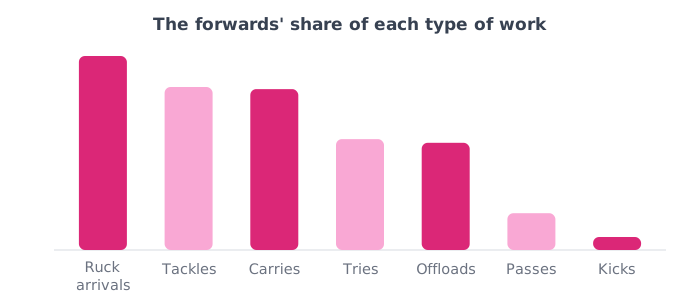
The pack owns the contact, the backs own the ball
Split the total by type of work and the dead heat explodes. The forwards put in very nearly three ruck arrivals in four and about three in five of the carries and tackles. The backs answer with about six passes in seven, nineteen kicks in twenty, and roughly three tries in five - plus most of the offloads. There is no overlap zone: contact work runs one way, ball work runs the other, and each unit’s dominant category is the other’s rounding error. Both versions of the argument are right about themselves and wrong about the other lot.
The busiest shirt belongs to neither camp
The involvement king is not a flanker or a centre. The scrum-half is the busiest shirt on the pitch by half as much again over the next player - a workload built almost entirely from passing, while putting in fewer ruck arrivals than anyone else in the fifteen. The nine sits outside the argument entirely: attached to the pack’s world, doing the backs’ work, touching the ball more than both. If involvement is effort, the changing-room argument has been missing its winner all along.
What to do with this
Audit Tuesday against Saturday. If the pack does three fifths of the tackling, does it get three fifths of the tackle work in training - and do your backs get live passing under fatigue in anything like the volume the match demands? Most training plans are traditions, and this split is a cheap way to check yours against reality. Praise in both currencies too: a review that only names carries and tries pays one unit’s wages, as the try-scoring table makes plain. Seeing your own club’s split needs every involvement tagged to a shirt, which is precisely the sort of counting worth buying rather than doing - the buyer’s checklist covers which platforms tag player by player.
How we worked this out
Based on millions of shirt-attributed involvements - carries, tackles, passes, ruck arrivals, kicks, offloads and tries - recorded across thousands of fully analysed matches spanning every variety of rugby, men’s and women’s, from amateurs to professionals, deduplicated so no fixture is counted twice. We split every involvement by shirt number, one to eight against nine to fifteen, excluding involvements where the shirt could not be read and the roughly one involvement in six worn by jerseys above fifteen, since replacement shirts do not map reliably onto positions at amateur level. The check that the split is measuring roles rather than noise is its consistency: every category leans the direction position coaching predicts, and the try shares independently match our position-scoring analysis. One honest caveat: the shirt is a strong but imperfect proxy for the role, and team-level events like scrums and lineouts carry no shirt at all, so set-piece graft is invisible here - which shortchanges the pack, not the backs. Figures reflect the analysed team’s events, the side of the game our data captures most completely.
Hero photo: Gabinho, CC BY-SA 4.0, via Wikimedia Commons.