Listen to any coaching conversation and rugby sounds like a game of long possessions. Phase seven. Go through the phases. Build pressure. We wanted to know what a phase count actually looks like when you stop talking about it and count it, so we took tens of thousands of attacking sequences from thousands of fully analysed matches spanning every variety of rugby, men’s and women’s, from amateurs to professionals, and followed each one from first contact to the moment the ball stopped coming back.
The typical attack is three phases long
Not seven. Not ten. The median attacking sequence runs to three phases. The average is a shade under four, dragged upward by a small number of very long possessions, which is exactly how you would expect a count like this to behave.
Put differently: by the time your gameplan reaches the move you spent Tuesday drilling, most attacks in the match are already over.
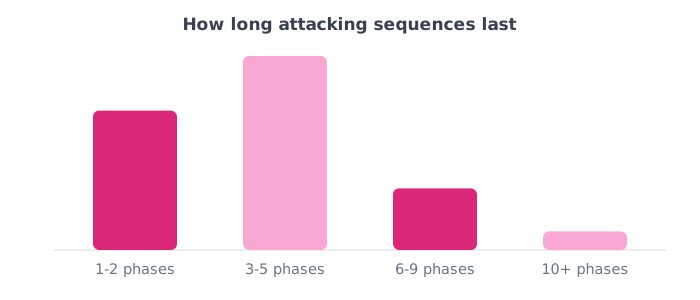
A third of attacks are done inside two phases
The distribution is front-loaded and it is blunt about it. Around a third of sequences end within two phases. Roughly another half run to somewhere between three and five. Only about one in seven reaches six or more, and the genuinely long possession, ten phases or beyond, turns up in fewer than one sequence in twenty.
The famous multi-phase siege is real. It is just rare enough that building your whole attacking structure around it means building for the exception.
The count barely moves when you change the definition
Phase counting depends on where you decide one possession ends and the next begins, so we ran it three ways, with generous, moderate and tight rules for what still counts as the same attack. The median stayed at three every time and the average moved by less than half a phase across the lot. That stability is the useful part: this is not an artefact of one arbitrary choice, it is what the game looks like.
What to do with this
Audit your attacking shape against the phase count you actually get, not the one in the plan. If your first three phases are unstructured because the good stuff starts at four, you are improvising through the part of the attack that happens every single time and executing precisely in the part that mostly never arrives.
Two practical consequences. First, phase one and phase two deserve the most detailed preparation, because they are the only phases you are guaranteed. Second, the exit matters as much as the entry: most sequences end in a kick, an error or a turnover rather than a score, so the quality of how you finish an average attack shapes the match more than the quality of your best one. It also fits what we found about scoring: the typical try is a short, sharp thing, and quick ball does more for you than extra phases.
How we worked this out
Based on tens of thousands of attacking sequences drawn from thousands of fully analysed matches spanning every variety of rugby, men’s and women’s, from amateurs to professionals, deduplicated so no fixture is counted twice. We grouped consecutive breakdowns by the same team into a single sequence when they occurred close enough together in the match to belong to the same possession, and counted phases as the breakdowns in that sequence plus the carry that started it. We ran the grouping at three different time thresholds to check the answer was not an artefact of one; the median was unchanged at all three. One honest limitation: a sequence only becomes visible to us once it produces a breakdown, so possessions that ended in a kick, an error or a turnover before any breakdown are not counted. Those are the shortest attacks of all, which means the true typical attack is, if anything, shorter than the figure here. Sequences are those of the team being analysed, the side of the game our data captures most completely.
Hero photo: Léna, CC BY 3.0, via Wikimedia Commons.