
Momentum is rugby’s favourite ghost. Commentators narrate it, coaches plan for it, players swear they can feel it: score once and the next score comes easier, concede and the tide is against you. We went looking for it. Across thousands of fully analysed matches, from every variety of rugby, men’s and women’s, from amateurs to professionals, we lined up tens of thousands of pairs of consecutive tries and asked one question: after a try, who scores next?
The team that just scored usually scores next. That proves nothing.
First, the raw answer: the team that just scored also grabs the next try slightly more often than not. Case closed? Not remotely. Strong teams score most of the tries in their matches, so of course the scorer of any given try is favourite to score the next one. They were favourite before they scored, too. To find momentum, you have to ask a sharper question: does scoring make a team more likely to score next than its overall quality already predicted?
The runs match what shuffling predicts
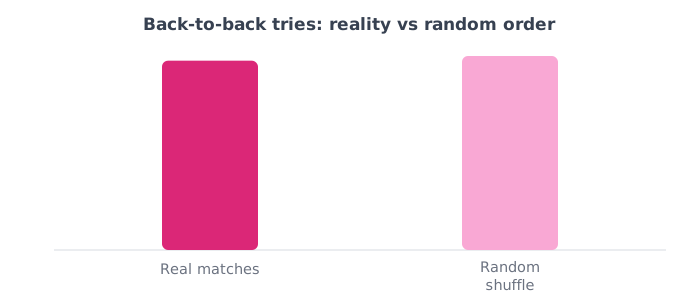
Here is the test. Take each match’s tries and imagine dealing them out in a random order, like shuffling a deck: a strong team that scored most of the match’s tries would still produce plenty of back-to-back scores by pure arithmetic. Compare that shuffled expectation with what actually happened, and the two numbers land within about a point of each other, with reality a whisker below the shuffle. Read that again: real matches contain no more scoring runs than random ordering produces. The three-tries-in-ten-minutes burst you remember was not a wave building. It was a good team being good, in an order that felt meaningful afterwards.
Even the clock refuses to cooperate
If momentum were real, you would expect the follow-up try to arrive faster when the same team strikes twice, the surge in full flow. It does not. The typical wait for the next try is a little over six minutes whether it comes from the team that just scored or the team that just conceded. No surge, no tide, just rugby continuing at rugby’s pace. And the famous run of three? Nearly three quarters of higher-scoring matches contain one, which sounds like proof of momentum until you notice it is exactly what a lopsided try count produces on its own.
What to do with this
This is one of the most liberating results in our whole series. If momentum is a story told after the fact, then conceding is just conceding: the next passage starts even, you receive the restart, and the response is yours to script, not the tide’s. Coach your team’s next two minutes after any score, for or against, as a routine: same restart plan, same first exit, same defensive set. Teams that believe in momentum give away real things when they are chasing the ghost, panicked exits, forced offloads, rushed penalties. The scoreboard, as our comeback data shows, moves for the team that keeps its head.
How we worked this out
Based on tens of thousands of consecutive-try pairs across thousands of fully analysed matches spanning every variety of rugby, men’s and women’s, from amateurs to professionals, deduplicated so no fixture is counted twice. For each match we compared the actual frequency of back-to-back tries by the same team with the frequency random ordering of that match’s own tries would produce, so team strength is fully accounted for. Timing figures use the tagged video timestamps of each try. Both teams’ tries are counted. We looked for momentum as honestly as we could, and we would have enjoyed finding it.
Hero photo: PierreSelim, CC BY-SA 3.0, via Wikimedia Commons.