Every coach knows the halves touch the ball more than anyone else. Almost nobody knows by how much. We took the passing record from thousands of fully analysed matches spanning every variety of rugby, men’s and women’s, from amateurs to professionals, and counted every pass by the jersey that threw it. The scrum-half alone throws getting on for half of a team’s passes, and the 9 and the 10 together handle more than the other thirteen players put together.
The scrum-half throws getting on for half of everything
Across the whole dataset, the 9 accounts for getting on for half of all passes his side makes. In a typical single match the figure is a little higher still, closer to one pass in two. No other jersey is within touching distance: the 10 is a distant second at about one pass in seven, and after that the numbers fall away sharply into the low single figures.
That gap is the thing worth sitting with. The busiest passer in the team outthrows the second busiest by roughly three to one, and the second outthrows the third by about three to one again.
Two jerseys outweigh the other thirteen
Put the halves together and they account for about three passes in five across the data, and in a typical match closer to two in three. Every other player on the pitch, the other six backs and the entire pack, shares what is left.
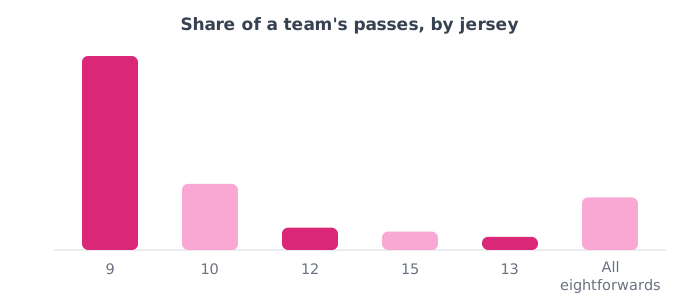
The pack comparison is the one that tends to surprise people. All eight starting forwards, added together, throw about one pass in eight - comfortably less than the 10 on his own, and less than a third of what the scrum-half does by himself. Forwards carry, clear and tackle; the distribution of the ball is very nearly a two-man job.
Not every team is built this way
The averages hide a real spread, and the spread is the useful part for a coach. In the tightest tenth of team performances the two halves handle under two passes in five between them. In the most concentrated tenth they handle more than three quarters.
That is a genuine stylistic difference rather than noise, and it is measurable in your own side within a couple of matches. Neither end of the range is wrong. What is worth knowing is which one you are, and whether you meant it.
What to do with this
Check your own split before assuming you sit near the average, because the honest answer decides what you do next. If your halves are handling three quarters of the ball, your attack has one obvious failure mode: take the 9 out of the game, whether through injury or pressure at the breakdown, and the whole structure narrows. That is an argument for a genuine second distributor rather than a deputy, and for training the backup properly rather than hoping.
If your halves are down near two in five, the ball is going wide early and often, which brings its own trade-offs in how many passes a try actually takes and in where the scoring ends up landing by position.
How we worked this out
Based on the passing record across thousands of fully analysed matches spanning every variety of rugby, men’s and women’s, from amateurs to professionals, deduplicated so no fixture is counted twice. We counted every recorded pass against the jersey number that threw it, restricted to matches with a substantial passing record so that a thin one cannot swing a share, and report both the pooled figure across all passes and the median of the per-match shares, which is why two slightly different numbers appear for the same idea. The method contains its own check: the replacement scrum-half’s jersey comes out as one of the busiest numbers on the pitch, sitting above every starting forward, which is exactly what should happen if squad numbering is broadly conventional and the jerseys are being read correctly. One honest caveat: teams number their squads however they like, so a 9 is not guaranteed to be a scrum-half, and any club that numbers unconventionally is diluting the effect rather than inflating it - the true concentration is if anything slightly higher than what we report. Passes where the jersey could not be read are excluded rather than guessed. Team figures reflect the analysed team’s events, the side of the game our data captures most completely.
Hero photo: Naparazzi, CC BY-SA 2.0, via Wikimedia Commons.