A rugby team attempts around a hundred tackles in a match, the quietest quarter of teams under eighty and the busiest over a hundred and twenty, and the busy ones usually lose. “Ninety tackles today - immense effort.” The tackle count is the most quoted number in amateur defence, read out after a loss as proof the team fought. We put it against results, across hundreds of thousands of tackle attempts collected from every variety of rugby, men’s and women’s, from amateurs to professionals, and the number turns out to be pointing the other way. The team that tackles more usually loses - and the more they tackle, the more usually they lose.
The quietest defences win almost two in three
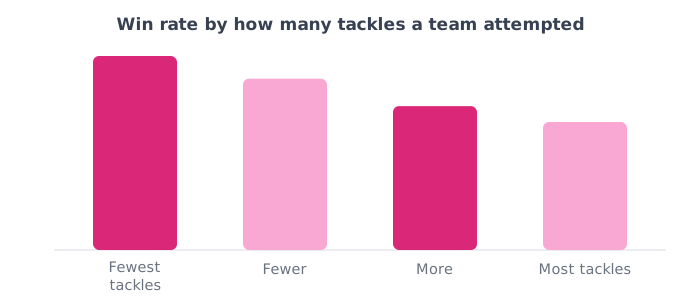
Sort matches by how many tackles the team attempted and the gradient is clean and unbroken. Teams in the quietest quarter - up to about eighty attempts - win almost two matches in three. The busiest quarter, from around a hundred and twenty attempts upwards, wins just over two in five. Every step busier is a step likelier beaten, with no flat stretch anywhere: the big defensive shift the count celebrates is, on average, the shape of a defeat.
It is not that busy teams tackle badly
The obvious objection is that teams making lots of tackles are simply missing lots too. So we held quality still: compare teams with the same tackle completion, split only by workload. The gap survives. Among teams completing well, the quiet ones win about seven matches in ten and the busy ones fewer than three in five - and the same stagger appears among teams completing poorly. Tackling well matters more than tackling little, and completion remains the skill number worth chasing. But at any given standard of tackling, a heavy count is bad news.
A tackle count is a possession meter
The reason is what the count is really measuring. A tackle only happens when the other side has the ball, so a tackle count is a clock running on your time without it. The check is in an entirely separate stream: matches where a team attempts more tackles are matches where the opposition builds more rucks, and the two rise together almost in lockstep - rucks being recorded independently of tackles. Read that way, the number makes sense at last. “Ninety tackles” does not mean the defence had a great day. It means the defence was the only unit getting work.
What to do with this
Stop reading the tackle count as effort and start reading it as exposure. A rising count across a season is telling you about your exits, your kicking game and your breakdown - the things deciding how much defending you have to do - which is the same lesson the collision numbers teach from the other side of the contact. Praise defensive quality instead: completion, and dominant tackles, which stay rare and precious. And if your club’s only defensive number is the count somebody keeps in their head, the fix is measurement, not motivation - choosing a platform that tags tackles for you turns this whole post into a column your coaches can watch move.
How we worked this out
Based on hundreds of thousands of tackle attempts across thousands of fully analysed matches spanning every variety of rugby, men’s and women’s, from amateurs to professionals, deduplicated so no fixture is counted twice. A team’s workload is its made plus missed tackles - assists excluded - and we compared workload with results in matches with a decided winner, the score derived from the tries, conversions, penalties and drop goals we recorded. The check that the count means what we claim: tackle attempts rise almost in lockstep with the opposition’s ruck count, which is recorded independently of tackling, so the number really is a meter of time spent defending. One honest caveat: this is an association, not a mechanism - weaker teams both defend more and lose more, so a big count is a symptom of being under pressure rather than a cause of defeat, and tackling less is not the prescription. Tackle detail is recorded for the analysed team, the side of the game our data captures most completely, and analysed teams are often the stronger side.
Hero photo: Charlie from UK, CC BY 2.0, via Wikimedia Commons.