Ask what a good tackle completion rate is and you will hear numbers borrowed from the professional game: ninety per cent, ninety-five on a good day. Those numbers are real, and they are also useless to most teams, because they describe full-time athletes. We took the tackling record of the analysed team in thousands of fully analysed matches, from every variety of rugby, men’s and women’s, from amateurs to professionals, and worked out what completion actually looks like when the tacklers have day jobs.
The honest baseline is about seven in ten
In a typical match the analysed team attempts close to a hundred tackles, and just over seven in ten of them stick. Half of all team performances land between about two thirds and just under four in five. So if your side completes around three quarters of its tackles, you are not leaking, you are normal. The pro benchmark is a different sport played on the same pitch.
Better than four in five is genuinely elite
At amateur level, a completion rate better than four in five puts a team performance in roughly the top tenth of everything we have collected. That is the realistic ceiling to chase: not ninety-five per cent, but a match where four of every five would-be tacklers get their man down. Teams occasionally post pro-level numbers on a great day. They do not live there.
The link to winning is the steepest we have found
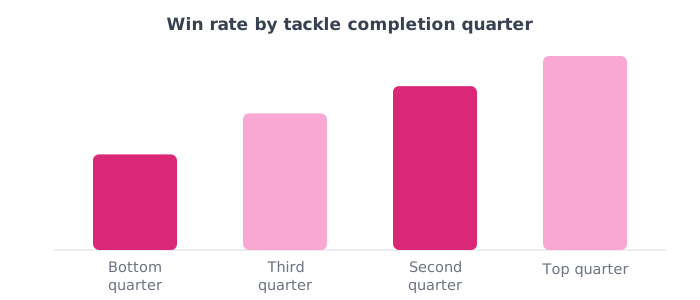
Here is why the number deserves a place on your whiteboard. Split every team performance into quarters by completion rate and look at results: the bottom quarter won about one match in three, while the top quarter won about seven in ten. That climb, quarter by quarter, is the steepest link between a single team stat and winning that we have found in this series, steeper than possession, steeper than the breakdown. Some of it is simply that better teams tackle better. But missed tackles are the most direct currency in the game: each one hands over metres, momentum and, as our try data keeps showing, points.
What to do with this
Stop importing professional targets that guarantee your team a failing grade. Set the benchmark from the level you actually play at: three quarters is solid, four in five is a target with meaning, and anything above that is a performance to celebrate. Then coach the misses, not the number, because a completion rate improves one bad read and one poor shoulder height at a time. Track it weekly and treat a slide below two thirds as an alarm, since that is the neighbourhood where losing becomes the expectation. It pairs naturally with the work-rate picture of a match, where defence turns out to be most of the volume.
How we worked this out
Based on the tackling record of analysed teams in thousands of fully analysed matches spanning every variety of rugby, men’s and women’s, from amateurs to professionals, deduplicated so no fixture is counted twice. A tackle attempt is either completed or missed; assists on someone else’s tackle are excluded from both sides of the calculation, which is the strictest way to count and gives lower figures than methods that include them. Team performances with very few recorded attempts were set aside. Results come from scorelines rebuilt from the same tagged events, a method we have checked against externally recorded results, and analysed teams are often the stronger side, which will flatter the win rates at every completion level but not the climb between them.
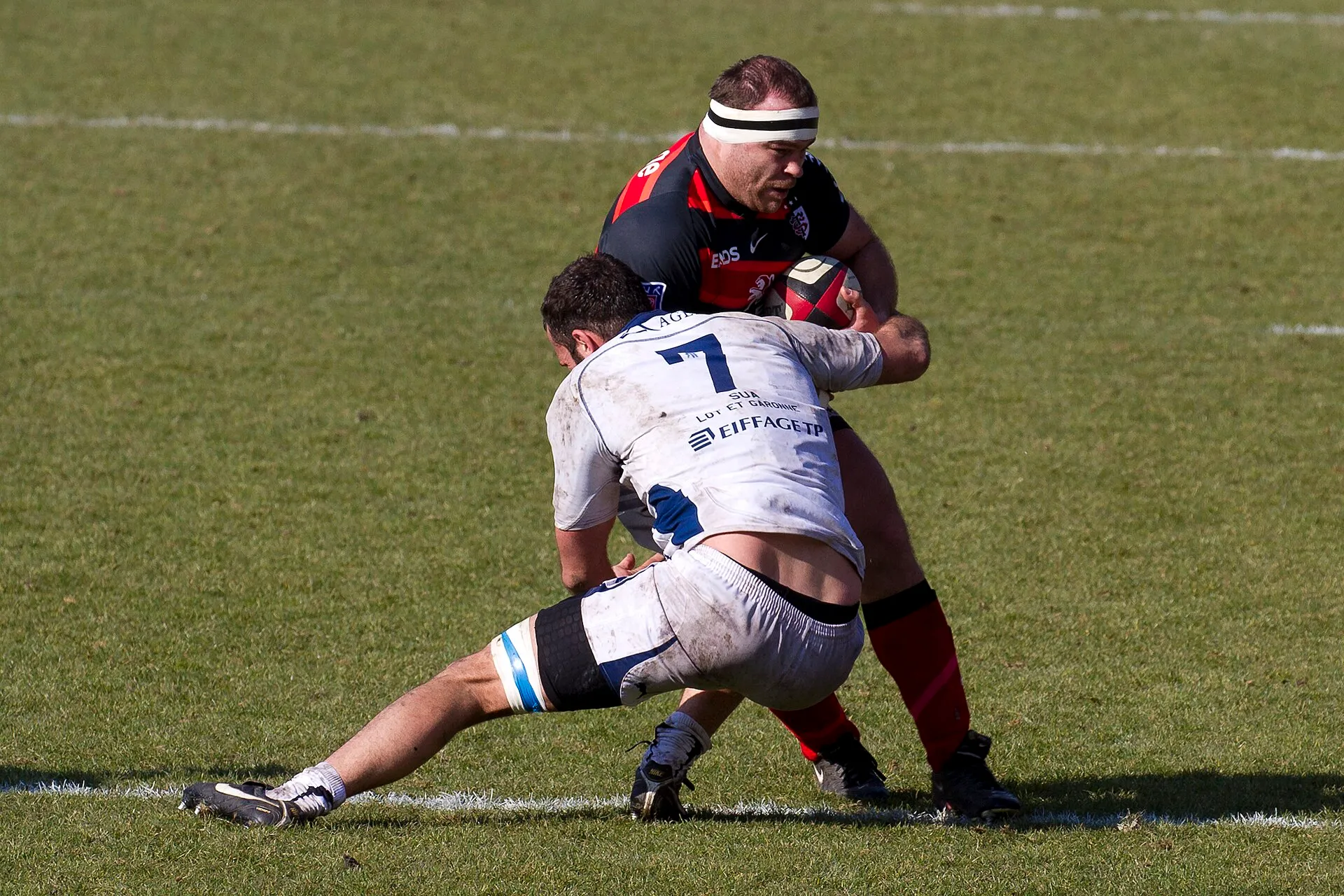
Hero photo: Pierre-Selim, CC BY-SA 3.0, via Wikimedia Commons.