Ask a coach what happens in a rugby match and you will get a feeling. Ask our database and you get a count. We collect nearly seven hundred data points per match, across thousands of fully analysed matches spanning every variety of rugby, men’s and women’s, from amateurs to professionals. Put them all in one place and you get something surprisingly useful: a portrait of the average game, layer by layer. This is that portrait.
The ball is in play less than you think
Start with the number that surprises everyone: out of eighty minutes on the clock, the ball is actually in play for about twenty-five minutes. The rest is set pieces forming, kicks being lined up, and everyone catching their breath. That playing time splits into roughly seventy-five passages of play, each lasting about twenty seconds. A match is not one long effort. It is dozens of short, violent ones with pauses in between, which is worth remembering next time you plan a fitness block.
What a team actually does with the ball
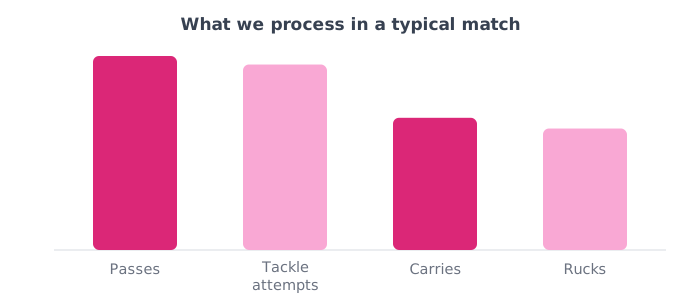
In a typical match the analysed team makes about ninety passes and around sixty carries, and takes the ball into more than fifty rucks. Add nine or ten offloads and roughly eight visits to the opposition 22, and that is the whole attacking output of an average game. Ninety passes sounds like a lot until you spread it across eighty minutes and fifteen players, at which point the case for making each possession count starts to make itself.
The defensive shift is bigger than the attacking one
The same team makes close to ninety tackle attempts, of which roughly seven in ten stick. Behind those tackles sit another fifty or so tackle assists, and we process more than a hundred and thirty arrivals at the breakdown over the course of a game. Defence is where the volume lives. If your training week is ninety per cent attack, the match is going to feel very different from Tuesday night.
The untidy bits
The average team gives away ten or eleven penalties and coughs the ball up with about seven handling errors a match. It receives about five restarts and contests around nine lineouts and eight scrums of its own. None of these numbers is glamorous, and together they quietly decide most games, because they are the moments where possession changes hands for free.
The scoreboard at the end
All of that activity produces nearly eight tries between the two sides and a combined fifty-ish points. Rugby at every level is a scoring game now. Shutouts are rare, big totals are normal, and the gap between the sides is usually built from the unglamorous layers above, not from one moment of brilliance.
What to do with this
Use the averages as a mirror. If your team kicks off on Saturday, you now know roughly what the match will contain: a handful of 22 visits, ten-ish penalties, seven-ish errors, ninety-odd tackles. Pick the layer where you are furthest from average and coach that first. And if you want the deeper dives, each layer of this post has one: how long the ball is really in play, how many passes a try takes, what indiscipline costs, handling errors and the breakdown.
How we worked this out
Based on the full event record of thousands of fully analysed matches spanning every variety of rugby, men’s and women’s, from amateurs to professionals, deduplicated so no fixture is counted twice. Per-match figures reflect the analysed team’s events, the side of the game our data captures most completely, and the try and points figures cover both sides. Ball-in-play and passage figures come from the same tagged events. Averages are exactly that: your Saturday will vary, which is rather the point of measuring it.
Hero photo: PierreSelim, CC BY-SA 3.0, via Wikimedia Commons.