The ball is in play for about 25 minutes of an 80-minute rugby match. Everyone knows a match lasts 80 minutes; almost nobody knows how little of that is rugby. Between scrums being set, lineouts forming, kicks being teed up, injuries, water breaks and the general theatre of the game, the ball spends a remarkable amount of an afternoon doing nothing. Elite rugby has published numbers for this. Below the professional game nobody had, because nobody had the data. We do, so we measured it.
About 25 minutes
Across thousands of full-length matches in the Framesports data, from every variety of rugby, men’s and women’s, from amateurs to professionals, the ball is in play for a median of around 25 minutes. Not 60, not 40. Twenty-five. Under a third of the scheduled 80 contains live rugby, and half of all matches sit between roughly 22 and 29 minutes. However long your players think they play for, the real answer is: about as long as an episode of a sitcom. The match itself runs well past 80 minutes on the clock, and we timed that too.
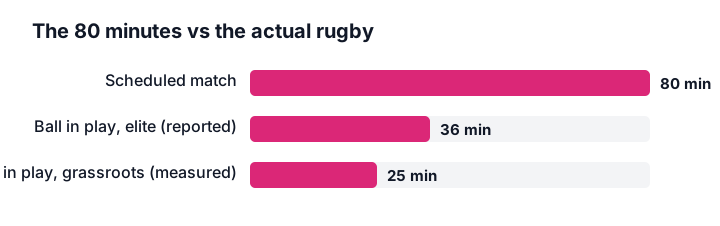
For context, World Rugby has reported elite ball-in-play figures in the mid-to-high thirties in recent tournaments. The gap makes sense: professional games have shot clocks enforced, slicker restarts, fewer uncontested resets and far fewer “hang on, whose ball is it” moments. The further down the pyramid you go, the more of the afternoon evaporates into stoppage.
The game happens in 20-second bursts
The total is only half the story. The shape of that 25 minutes matters more. The average match breaks into roughly 75 passages of play, and the average passage lasts about 20 seconds. The median match’s longest single passage of continuous rugby, the one that ends up on the highlight reel, runs a bit under two minutes, and that is the outlier, not the pattern.
So the true shape of rugby at this level is: twenty seconds of intensity, a pause, and again, seventy-odd times. It is a sprint-repeat sport wearing the costume of an endurance one.
What this means for training
If your training doesn’t look like the game, this is the data to change it. Three practical translations. First, condition in bursts, not slogs: repeated 20-to-40-second high-intensity efforts with short resets mirror what players will actually face, in a way that a continuous fifteen-minute drill never will. Second, coach the restart moments: with 75 passages a match, there are 75 transitions where concentration lapses are cheap to fix and expensive to ignore, which is where set-piece quality quietly decides games. Third, treat possession as scarce: if there are only 25 minutes of rugby, a team that wastes three or four possessions has burned a meaningful share of its whole match. That mindset shift, from “we have all game” to “we have 25 minutes”, is free, and it changes how players value the ball. It is the same lesson our kicking data taught: every choice with the ball has a price.
Why the community game should measure its own number
Elite ball-in-play stats get quoted at coaching courses as if they describe everyone’s rugby. They don’t. Your matches contain less continuous play, shorter passages and more restarts than a Test match, which means the elite training templates need translating down, not copying. This is a recurring theme when we look at rugby by the numbers: the community game is not a slower version of the pro game, it is a differently shaped one.
How we worked this out
Based on thousands of analysed full-length matches spanning every variety of rugby, men’s and women’s, from amateurs to professionals, deduplicated so no fixture is counted twice. We reconstruct passages of play by clustering the timestamped events we record, tackles, carries, rucks, passes, kicks, and measuring the span of continuous action, treating gaps longer than a few seconds as stoppage. It is a conservative estimate measured in match-video time, and the result is stable whichever reasonable threshold we pick. One honest caveat: analysed teams are often the stronger side, and the figures describe the matches on our platform rather than the whole game; the elite figures referenced are World Rugby’s published tournament numbers.