The short answer: a rugby union match is eighty minutes long, two halves of forty with a half-time break of no more than fifteen minutes, plus whatever the referee adds for stoppages. Age-grade matches play shorter halves. That is the game on paper.
The long answer is the one that matters if you are booking a pitch or standing on a touchline, and it is a number nobody writes down. We measured it, across thousands of fully analysed matches spanning every variety of rugby, men’s and women’s, from amateurs to professionals - the elapsed time from the first recorded event to the last. Plan for about an hour and a half.
Ninety minutes is the middle of the road
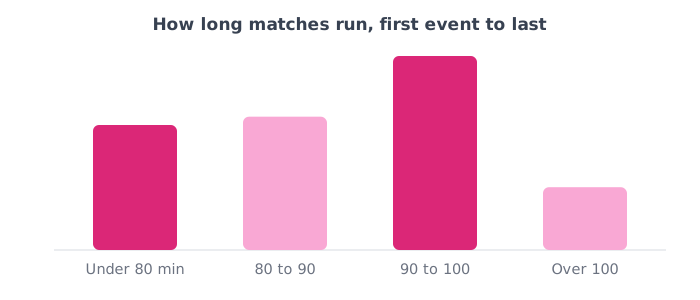
The median match runs about an hour and a half from first event to last. Around it sits a wide spread: about a quarter of matches wrap up inside eighty minutes - shortened formats and younger age grades mostly - another quarter land in the eighties, and getting on for two in five run somewhere in the nineties. The eighty-minute match of the laws is not the typical match. It is roughly the short end of the adult game.
How long is half time in rugby? About seven minutes, for most teams
Where we can locate half time, the two halves come out at about forty minutes of recorded play each, first half and second half nearly identical - which is also the check that the method is finding the real interval. The surprise is the break: the gap between the last event of one half and the first of the next is about seven minutes for the typical match, and only one match in ten stretches it past eleven. The professional game’s long tunnel interval is not the amateur norm. Most half-time talks happen on the pitch, fast, with the clock effectively still running on everyone’s afternoon.
One match in eight runs past a hundred minutes
The long tail is real: about one match in eight goes beyond a hundred minutes from first event to last. Injuries, stoppages, uncontested-scrum resets and slow restarts all stretch the same nominal eighty. If you have ever felt a match dragging into a second afternoon, roughly one Saturday a season, you were not imagining it. And elapsed time is still not rugby played - within that hour and a half, the ball is live for far less than you would guess.
What to do with this
Schedule against the real number, not the official one. Pitch slots, referee bookings, curtain-raisers and live streams planned around eighty minutes will collide with reality about half the time; an hour-and-three-quarters slot almost never will. For coaches, the seven-minute break is the more useful figure - a half-time plan with three points in it is a plan for an interval you do not have, so decide the one change that matters before the whistle. And for whoever handles your footage, the match is a two-hour file: most of the cost of analysis is the time it takes a person to get through one, which is worth knowing before you volunteer for a season of it. For what fills those minutes, the anatomy of an average match breaks it down event by event.
How we worked this out
Based on close to three million events recorded across thousands of fully analysed matches spanning every variety of rugby, men’s and women’s, from amateurs to professionals, deduplicated so no fixture is counted twice. A match’s span is the elapsed time from its first recorded event to its last, so it includes stoppages but not the warm-up or anything after the final play; matches with too few events or implausible spans were excluded rather than guessed at. Half time is found as the longest quiet gap in the middle portion of the match, and the check that this works is that the two halves it produces come out almost exactly equal in length across the cohort - they do, at about forty minutes each. One honest caveat: the clock here is the match as recorded, so a filming pause would read as playing time, which if anything stretches the long tail rather than creating the pattern. Timings reflect analysed matches, the fixtures our data captures most completely.
Hero photo: Henning Schlottmann (User:H-stt), CC BY-SA 4.0, via Wikimedia Commons.