Every touchline has one person saying a lead is never safe in rugby and another who starts celebrating with ten minutes to go. We have already looked at what a lead is worth twenty minutes in. This time we rebuilt the scoreboard through the last half hour of thousands of matches, from every variety of rugby, men’s and women’s, from amateurs to professionals, and followed every lead to the final whistle. With ten minutes left, a lead of a converted try or less is lost about one time in four. Two scores is where a lead starts to be safe.
A one-score lead barely gets safer as the clock runs down
With twenty minutes left, a team leading by seven points or fewer goes on to win a little under three times in four. With ten minutes left it is about three times in four, and with three minutes left about four times in five. The clock keeps running and the odds hardly move.
The reason is plain arithmetic. One score cancels a one-score lead, and there is nearly always time for one more score. The smallest leads are the most fragile of all: a lead of a penalty or less with three minutes to go is still lost about one time in four.
Two scores changes the picture
Past a converted try, a lead behaves differently. A lead of eight to fourteen points with twenty minutes left holds better than nine times in ten. With ten minutes left it holds better than nineteen times in twenty, and with five left the team in front almost never loses.
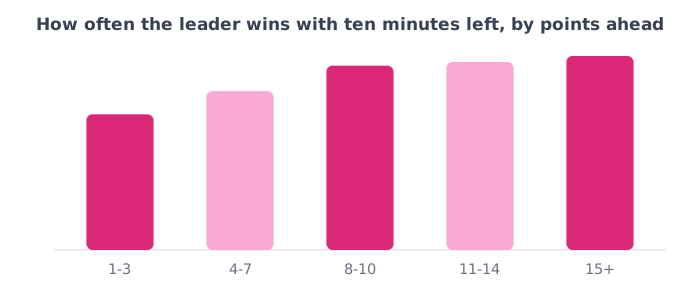
Look at the middle of that chart. A team seven points up with ten minutes left wins about four times in five. Three more points takes it to about nineteen times in twenty.
Fifteen points with twenty minutes left is as good as over
Lead by fifteen or more with twenty minutes to go and the game is all but finished: the chasing side came back to win about once in two hundred matches. The comebacks that do happen late come almost entirely from close range. More than four in five of the matches that turned around in the last ten minutes started from a deficit of a converted try or less.
What to do with this
If you are a score up with ten minutes left, the clock is not yet on your side. You hold on about three times in four, and that will not rise much as the minutes tick down. The next score is what changes it, and a kickable penalty that takes a seven-point lead to ten is worth more than it looks: it moves you from about four in five to about nineteen in twenty.
If you are a score behind, you are in a live game, and about one team in four in your position still wins. Two scores behind with ten to go, the comeback comes off about once in twenty-five matches. Seeing where your own late leads came from, and where they went, needs every match recorded and timed, which is cheaper than most teams assume: the cheapest way to get rugby analysis done.
How we worked this out
Based on the scoring events across thousands of fully analysed full-length matches spanning every variety of rugby, men’s and women’s, from amateurs to professionals, deduplicated so no fixture is counted twice. We rebuilt each scoreline from tries, conversions, penalties and drop goals, took the score at fixed points counting back from the end of the recorded match, and compared it with the result, leaving out matches level at that point or level at full time. The method checks itself: forty minutes from the end lands close to half time, and the team in front there went on to win just over four times in five, the same answer our half-time comeback analysis reached by finding the break a different way. The late-lead figures also barely move when we keep only matches where our rebuilt score is identical to the official one. One honest caveat: the clock is the match as recorded, stoppages included, so ten minutes left means ten minutes of footage rather than the referee’s watch. Analysed teams are often the stronger side, but every comparison here is leader against chaser in the same match.
Hero photo: Adam Baker (AlphaTangoBravo), CC BY 2.0, via Wikimedia Commons.