The number 8 carries the ball more than anyone else in a rugby team, by a distance. We collected every carry by the shirt number of the player who made it, across thousands of matches from every variety of rugby, men’s and women’s, from amateurs to professionals. The 8 carries about six and a half times a match, a third more than any other shirt, and the inside centre carries as often as the openside.
The 8 carries a third more than anyone else
The 8 averages about six and a half carries a match. The next two shirts, the 7 and the 12, manage nearly five, so the 8 carries about a third more than anyone else on the pitch. The 8 is the forward who can pick up from the base of the scrum, and plenty of teams use them as the first carrier when they need metres close to the ruck.
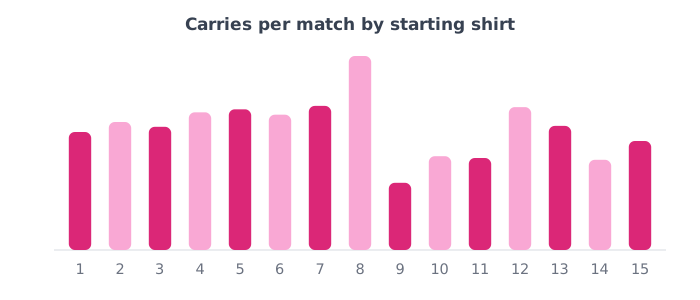
Behind the 8 the forwards are bunched. Both locks and the blindside carry four or five times a match, and the hooker and both props carry about four. Every starting forward carries about four times a match or more, and the pack makes about three carries in five between them, the same split we found in forwards or backs: who does more.
The 12 carries as often as the openside
In the backs, the inside centre carries as often as the 7, nearly five times a match and more than any other back. The 13 comes next with about four, and the rest of the backs carry less, down to the scrum-half.
The 12 is the back many teams use for the crash ball, a direct run into contact to get over the gain line and give the next phase quick ball. It shows in tackling as well: the 12 makes about as many tackles as a lock.
The scrum-half carries least
The 9 carries about twice a match, about a third as often as the 8 and the fewest of any starting shirt. The scrum-half has the ball at almost every ruck, and nearly every time the job is to pass it on.
The fly-half and both wings carry about three times a match each. The full-back carries a little more than either wing, between three and four.
What to do with this
Put your contact work where the carries are. Your 8 carries more than anyone, so their footwork into contact, body height and ball placement are worth the most time. Every forward carries about four times a match, so the props and the hooker need the same carrying work as the back row, with the same standard for going low and placing the ball back fast. Your 12 carries like a back-rower, so give them the back-row drills too.
Then count your own team. Carries per player per match, from the video of your last few games, set next to the order above, shows whether the players you expect to carry are the ones carrying. If your 8 carries less than your props, check whether that is the plan.
How we worked this out
Based on about a quarter of a million carries across over 4,000 fully analysed full-length matches spanning every variety of rugby, men’s and women’s, from amateurs to professionals, deduplicated so no fixture is counted twice. Each carry is recorded against the shirt number of the player who made it, and we used the shirt as a stand-in for position, which is fair where teams number their starting fifteen in the usual way. We divided each shirt’s carries by the number of matches, so a match where a shirt made no carries still counts. Carries by replacements and carries where the number could not be read are left out. To check the order is real rather than noise, we split the matches at random into two halves: the 8 came top and the 9 bottom in both, and the 7 and the 12 swapped second place. These are carries per match for the shirt, not per minute played, so shirts often replaced early, props especially, would look a little higher over a full game. Carry detail is recorded for the team being analysed, the side of the game our data captures most completely.
Hero photo: etgohome1, CC BY 2.0, via Wikimedia Commons.