Ask who makes a team’s tackles and most people point at the back row. They are right, and the rest of the picture is more useful than the obvious answer. We collected every made tackle by the shirt number of the player who made it, across thousands of matches from every variety of rugby, men’s and women’s, from amateurs to professionals. The openside makes the most, the back row makes more than a quarter of the tackles between them, and the inside centre tackles as often as a lock.
The 7 makes one tackle in ten, and the back row more than a quarter
The number 7 makes more tackles than any other starting shirt, about one in ten of everything the fifteen starters make, which comes to six or so a match. The 6 and the 8 come next, level with each other. Put the three back-row shirts together and they account for more than a quarter of the team’s tackles, the same shirts that clear the most rucks.
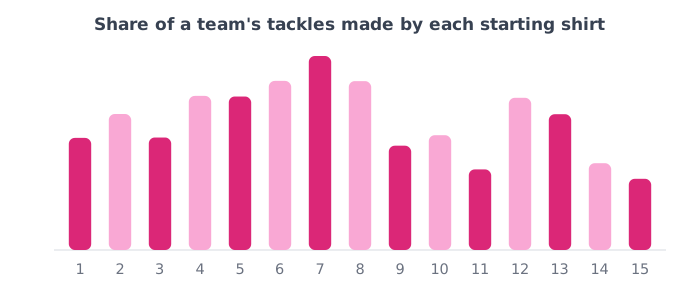
The locks follow, and the forwards as a whole make about three tackles in five. The starting backs make the other two in five.
The 12 tackles like a forward
In the backs, the inside centre makes more tackles than either prop and about as many as a lock, more than any other back. The 13 comes next among the backs, level with the hooker. The 12 stands closer to the forwards than any other back, in the channel where a lot of heavy carrying arrives, and the numbers show it.
At the other end of the pitch, the wings and the full-back make the fewest. The 7 makes nearly three times as many tackles as the 15.
Backs tackle less often and miss more when they do
Completion follows the same line. The forwards complete about three tackles in four, with the locks and the back row the most reliable of all. The backs complete closer to two in three, with the wings, the full-back and the half-backs at the bottom. And the 12 misses more tackles than any other shirt, which is the cost of all that traffic.
The gap says more about where each player tackles than about technique. A forward usually tackles close to the ruck, against a carrier with a few metres to build speed. A back tackles in space, against someone running at them from twenty metres out with room to step, where a miss is easier to make and harder to recover from.
What to do with this
Spread your tackle work the way the tackles are spread. The back row and the locks carry the volume, so repeat-effort defence belongs with them. Your 12 makes as many tackles as a lock, so give them a lock’s share of contact work. Your back three make the fewest tackles, but theirs are the one-on-ones in open space that become tries, so their work is angles, footwork and getting square.
For the team-wide number, see what a good tackle completion rate looks like. Tracking it player by player every week means someone recording every tackle, which is more work than most teams expect: do you need an analyst or just the analysis?
How we worked this out
Based on hundreds of thousands of made tackles across thousands of fully analysed full-length matches spanning every variety of rugby, men’s and women’s, from amateurs to professionals, deduplicated so no fixture is counted twice. Each tackle is recorded against the shirt number of the player who made it, and we used the shirt as a stand-in for position, which is fair where teams number their starting fifteen in the usual way. Assists are left out, tackles where the number could not be read are excluded, and so are shirts above fifteen, about one tackle in seven, because replacement shirts do not map reliably onto positions. To check the order is real rather than noise, we split the matches at random into two halves and ranked the shirts in each: the back-row and lock shirts filled the top five both times, with the 12 sixth in both. One honest caveat: some teams number their squads their own way, so the positions are approximate. Tackle detail is recorded for the team being analysed, the side of the game our data captures most completely.
Hero photo: Kerrie on Flickr, CC BY-SA 2.0, via Wikimedia Commons.