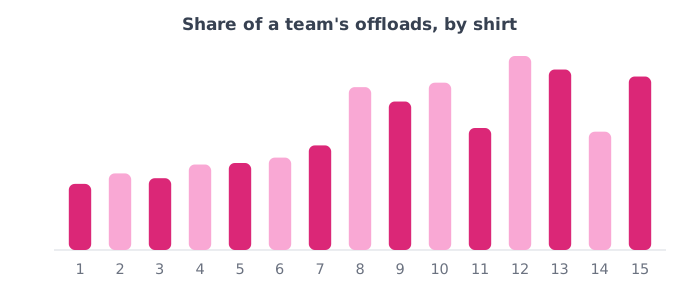
Ask who offloads in a rugby team and most people picture a big centre or a flanker slipping the ball out of a tackle. They are half right. We collected every offload by the shirt number of the player who made it, across thousands of matches from every variety of rugby, men’s and women’s, from amateurs to professionals. The inside centre offloads the most, the backs make about three in five, and the props make the fewest.
The 12 leads, with the 13 and the 15 right behind
A team makes about eleven offloads a match. The number 12 makes about one of them, around a tenth of everything the fifteen starters make, more than any other shirt. The 13 and the 15 come next, close together, then the 10.
That order makes sense when you think about where those players get tackled. A 12 takes contact in midfield with support on both sides, and a full-back is often tackled in open field with team-mates arriving. Both have somebody to pass to, and the defence is often stretched.
The 8 is the only forward near the top
The number 8 offloads about as often as the 10, and no other forward comes close. The blindside and the openside make about half as many as the 12, the locks a little fewer, and the front row the fewest of all. The 12 makes nearly three times as many offloads as the loosehead.
The gap has less to do with hands than you might think. Forwards carry at least as often as backs, but they mostly carry into a crowd, where keeping the ball is the job. A back gets away about one offload for every five carries. A forward gets away about one in ten, and the 8 about one in eight.
An offload wins more than a pass, and costs more
We compared what happened next after each offload and after each ordinary pass. Within thirty seconds of an offload, the same team scored a try about one time in seven. After a pass it was about one in nine. The risk is just as clear. About one offload in sixteen is followed straight away by a knock-on from the same team, against about one pass in thirty-three.
Teams also win more of the matches in which they offload more. Measured against its own usual number, a team wins about six in ten when it offloads above that number and a little under half when it offloads below. That is not proof that offloading wins matches. A team that is on top gets more chances to offload, since tired defenders leave more arms free, so some of that gap is winning causing offloads and not the other way round.
What to do with this
Coach the offload by position. Your 12, 13, 15 and 8 are the players who will use it, so that is where the repetitions belong, along with the decision about when not to throw it. A loosehead who practises offloads for ten minutes a week will use them perhaps once every three matches. Your support runners matter as much as the passer, because the risk comes from a pass nobody is ready for. If knock-ons are costing you, count which ones came from an offload before you tell anyone to stop throwing them. To see the wider split of work, read forwards or backs: who does more. Tracking this player by player means someone recording every pass in a match, which is the kind of job analysis software can take off your hands.
How we worked this out
Based on tens of thousands of offloads across thousands of fully analysed full-length matches spanning every variety of rugby, men’s and women’s, from amateurs to professionals, deduplicated so no fixture is counted twice. Each offload is recorded against the shirt number of the player who made it, and we used the shirt as a stand-in for position, which is fair where teams number their starting fifteen in the usual way. Offloads where the number could not be read are excluded, and so are shirts above fifteen, about one offload in seven, because replacement shirts do not map reliably onto positions. To check the order is real, we split the matches at random into two halves three times: the 12, 13 and 15 filled the top three places every time, and the 12 led in senior men’s and in women’s rugby separately. The try and knock-on comparisons look at what the data records next, so they show what tends to follow an offload and do not prove it caused the result. One caveat: scrum-halves carry so rarely that their rate per carry says little. Offload detail is recorded for the team being analysed, the side of the game our data captures most completely.
Hero photo: Naparazzi, CC BY-SA 2.0, via Wikimedia Commons.