Every club has a set piece it worries about. Judging by how training nights are spent, it is usually the scrum: the technical one, the dangerous one, the one that needs the specialist coach. We went looking for evidence that the worry is well placed. We collected tens of thousands of scrums and lineouts, from every variety of rugby, men’s and women’s, from amateurs to professionals, each recorded with which side put the ball in and whether they kept it. The answer is not the one most training plans assume.
The scrum is the most loyal set piece in the game
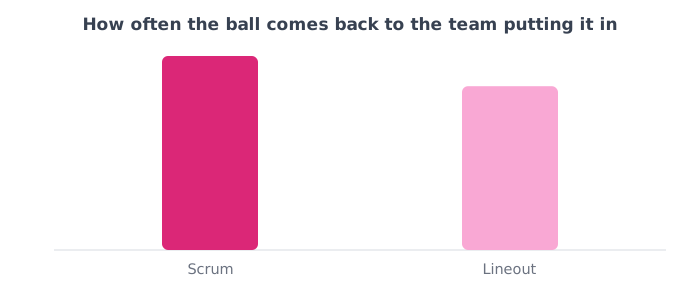
Put the ball into a scrum and you get it back almost nine times out of ten. That is a remarkably high number for a contest that involves sixteen people, and it holds for both sides of the match, not just the team being analysed. The lineout is nowhere near as generous: throw into a lineout and you keep it about three times in four. Same game, same teams, same afternoon, and one platform is meaningfully more reliable than the other.
The scrum’s reliability comes at a price in time
There is a catch, and it is the reason the scrum feels harder than the numbers say. Scrums collapse, wheel and get reset constantly: about one scrum in five has to be retaken, against roughly one lineout in fifty. So the scrum gives your ball back more faithfully, but it takes far longer and far more attempts to do it. The lineout is quick and decisive, and sometimes decisively bad.
That trade explains a lot about how a match feels. Ten minutes lost to resets is ten minutes your backs spend standing still, and it is why a scrum-heavy game drags. It is also why the scrum is over-represented in a coach’s memory: you spend more of the afternoon watching it than any other set piece.
Which one actually costs you possession
Here is the part worth taking to selection. Both set pieces come round a similar number of times, roughly eight or nine of each per team per match. But because the lineout loses the ball far more often, it quietly hands over several possessions a game while the scrum hands over barely one. If you are looking for free ball to stop giving away, the lineout is where it is going, and it is going there in volume.
None of which makes scrum work optional. A scrum that cannot hold is a penalty machine, and penalties are a different problem from possession. But if your training week splits set-piece time evenly and your lineout is the one leaking, the split is wrong.
What to do with this
Audit your own two set pieces separately before you decide where Tuesday night goes. Count how often each one comes back to you and how often it needs a retake. If your scrum retention is near nine in ten and your lineout is closer to two in three, the lineout is your problem no matter how much more dramatic the scrum looks. Start with the simple fixes: throw to a fuller line before you reach for the clever ones, and remember that a large share of tries begin at the set piece, so the platform you keep is the attack you get to run. Our wider look at set-piece success rates puts both in context.
How we worked this out
Based on tens of thousands of scrums and lineouts recorded across thousands of fully analysed matches spanning every variety of rugby, men’s and women’s, from amateurs to professionals, deduplicated so no fixture is counted twice. Retention means the team putting the ball in kept it. Resets are excluded from the win and loss counts rather than treated as losses, and are reported separately as the retake rate. Both teams’ set pieces are included here, because these are the events we record for each side of the match, so the figures are not limited to the team being analysed. Analysed teams are often the stronger side, so treat the absolute rates as a guide and the gap between the two set pieces as the finding.
Hero photo: Helene Brasseur, CC BY 2.0, via Wikimedia Commons.