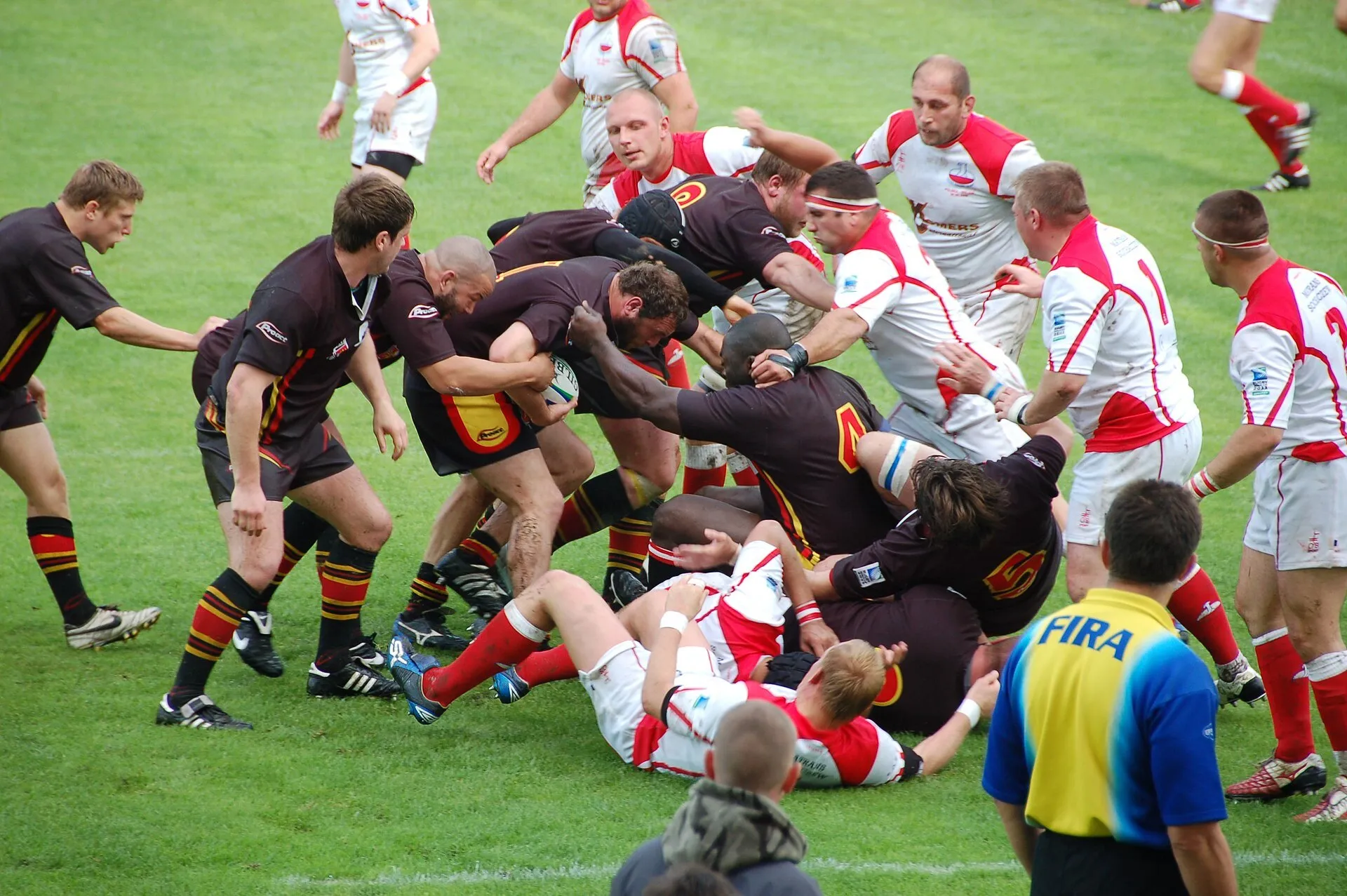
A team hits around sixty breakdowns a match, and arriving at one is the most common piece of work we record. From the touchline every breakdown looks the same: a tackle, a pile, a pass. What decided the pile happened a second before it and a metre away from it, which is why the breakdown is the part of the game coaches talk about most and coach least. Video is the only way to see it. Most breakdown video sessions are still useless, though, because they show the pile. Here is how to show the rest.
Watch the two seconds before the ruck
Rewind every breakdown clip to the moment the carrier is tackled and look at where the next two players are, the ones who are about to join the ruck rather than the ones already in it. If the first support runner is a metre behind the carrier when they go to ground, the ball is safe whatever the opposition does. If they are five metres back, the ball is a contest before anyone has bent over it. Almost every lost ruck in your footage was lost here, in the gap between the carrier and the support, and it is a gap you can coach because it is a running line and a decision rather than a technique. Watching the space rather than the ball is the whole skill, and the breakdown is where it pays most.
Clip the ruck you lost and the three before it
A turnover is rarely caused at the ruck where it happened. It is caused two phases earlier, when a carry went sideways, the support got strung out and the next carrier took the ball isolated. So when you clip a lost breakdown, clip the sequence that led to it, and ask the group where it was really lost. Players will point at the jackal. Push them back a phase. The moment the attack was in trouble is usually visible thirty seconds before the ball is, and once the group can see it, the fix is a running line at training rather than a lecture about body height.
Count arrivals, and read them out
The most common individual event we record is a player arriving at a ruck, and it is the one nobody counts, because nobody scores it. Count it. The pack does very nearly three arrivals in four, the second row and back row most of all, and reading a lock’s arrival count out at training does something to their season that no clip of a try ever will. It also tells you who is not arriving. A back rower with a low count is either being used elsewhere or hiding, and the footage will tell you which.
Time your ball
Quick ball is the most repeated instruction in rugby and one of the least measured. Our data says the typical ruck is cleared in about three seconds, and more than half are quicker than that. The slow ones are the problem, and they are easy to find: scrub to a ruck, count from the tackle to the scrum-half’s pass, and clip anything over five. Then look at why. Nearly always it is the carrier’s placement or the first arrival’s speed, and both are trainable. A second saved at one ruck is a defender still out of position at the next.
Coach the carrier on the ground
The collision itself is not the contest. The carrier wins getting on for nine collisions in ten, so most of the coaching value at the breakdown is in what happens after the carrier goes down: the fight to face their own side, the long placement, the ball held away from the first defender’s hands. Clip carries where the tackle was won and the ruck was still lost, and the placement will be the reason nearly every time. It is a habit, it is ugly to train, and it is worth more than another clearout drill.
Pick the moments to contest
Defensively the question is which rucks to attack and which to leave. The footage will show you a team competing at every breakdown and being penalised for it, or competing at none. Neither is a plan. Clip the turnovers you won and the penalties you gave away at the ruck, put them side by side, and let the group work out what the winning ones had in common. Usually it is an isolated carrier and a first defender already on their feet, and the losing ones are a player diving in because they were nearest. Winning the breakdown tilts a game. Giving away six penalties trying to does not.
Send each forward their own rucks
A session on the breakdown is a session for the pack, and the pack learns fastest from its own work. After the team session, send each forward a handful of their own arrivals with one question attached: were you first here, and if not, where were you? Players will watch their own moments when they arrive short and named, and a tight-head watching themselves arrive fourth to three rucks in a row learns more in two minutes than in a month of drills.
One theme a week
The breakdown has a dozen things you could coach and a group can hold one. Arrivals one week, placement the next, when to compete the week after. Under fifteen minutes, the same format as any other session, and straight out to the grass to train the one thing. The teams that get good at the breakdown are not the ones with the most clearout drills. They are the ones that could see it.
Hero photo: x-oph, CC BY-SA 2.0, via Wikimedia Commons.